
Lucky Lottery Numbers

This is a piece that I wrote for inclusion in my sister's book, Project Keepsake.
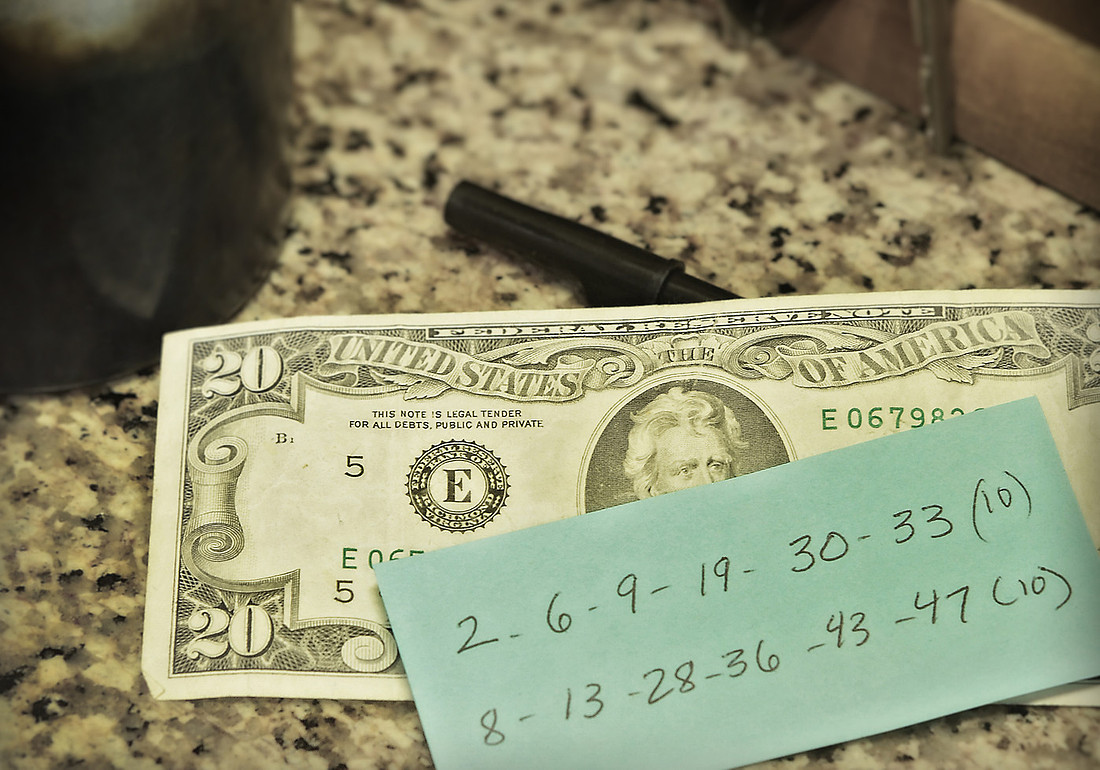

LUCKY LOTTERY NUMBERS
I pulled my navy blue Ford Explorer into the garage and quickly shut the overhead door to seal out the sweltering heat. It was August in Southern Illinois. The heat and humidity rivaled anything I had ever experienced in my seventeen years growing up in Middle Georgia.
I had just escorted my parents to the airport in St. Louis and driven the twenty-five miles back to my home in O’Fallon, Illinois. I stepped inside my kitchen, draped my purse over the back of a chair, and reached across the counter to hang my keys on the hook—that’s when I noticed the single scrap of pale blue paper. I studied it. It had been torn hastily from my notepad, and left deliberately on the center of my desk with a twenty dollar bill. Written on the piece of paper were two rows of numbers:
2 - 6 – 9 – 19 – 30 – 33 ($10)
8 – 13 – 28 – 36 – 43 – 47 ($10)
I recognized my father’s rushed handwriting and instantly understood what he had secretly left there for me to find upon my return.
I glanced at the clock and preformed some quick calculations in my head. My parents had surely touched down safely at the Atlanta airport by now and been greeted at their gate by my sister. Amber was responsible for helping them navigate the airport labyrinth and for driving them back to their home in Warner Robins, Georgia.
Standing alone in my kitchen, I smiled at the idea of playing Daddy’s lottery numbers for him. It was 1992 and at that time Georgia did not have a state lottery, but Illinois did. The possibility, albeit remote, of winning a $10 million jackpot intrigued my father. He had always been a bit of a gambling man—hustling unsuspecting men at local pool and billiard halls and taking his friends’ petty cash in late night games of poker. Playing the lottery was right up his alley, and the numbers written on that scrap of paper represented the extravagant dreams of a fifty-eight-year-old man.
I examined the digits closely. While the second row of numbers appeared to be completely random, the first row of numbers was familiar to me—each of those numbers represented a birth date of a member of our family. A sudden revelation ensued: my dad’s lucky numbers were our birthdays.
My older brother, Andy, was born on December 2. My younger sister, Amber, was born on August 6. The numbers 9, 19 and 30 are the respective birth dates of my mother, my father and me. The last number on that line, 33, represents the year in which my father was born.
My parents were traditional, middle class people who had been born and raised during the Great Depression in rural south Georgia. Both Mom and Dad were brought up in families of meager financial means, but both were raised in large, loving families rich in southern values, work ethics, and pride.
My parents said their vows in early December of 1956, and together, they raised three children. Like our parents, my brother, sister and I did not have a lavish upbringing, but we did enjoy the devotion of two loving parents who worked hard and made sacrifices so we could live comfortably. My dad worked two jobs to support our family and my mom worked from home as a bookkeeper. This allowed her to keep us properly supervised, well fed and safely chauffeured to our many extracurricular commitments.
We lived in a subdivision in a modest three bedroom, two bathroom house where we spent our summers riding bikes with neighborhood friends, picking wild plums and blackberries along a dirt road behind our house, and playing summer sports at a park just down the street. Although we never took elaborate vacations during those summer months, I never felt like I was missing out on anything. From time to time, my dad would contemplate driving across country to visit the the Grand Canyon or the California coast. His fondest desire was to one day travel to the icy, foreign landscape of Alaska, but the reality of raising three kids, working two jobs and eventually paying for all three of us to attend Georgia Tech prevented them from traveling to far away places.
The summer of 1992 would be different. My dad had recently retired from Robins Air Force Base where he worked for thirty-four years as a supervisor on the flight line in the Air Freight Terminal. All three of us kids had, by 1992, graduated from college and flown out of our parents’ nest. For the first time in their lives my parents were now free to pursue some of their dreams that had been long postponed. I had been living in the Midwest for the preceding three years and had not made as many trips home to visit my family as I should have. That particular summer, airfares from Atlanta to St. Louis were unusually low, making it cheaper and quicker to fly than to drive. So, with the encouragement of my sister, my parents boarded an airplane bound for St. Louis to visit my husband and me.
During their five day stay with us, we did the things that most tourists visiting the area would do: we saw the famous St. Louis Arch and marveled at the size and strength of the Mighty Mississippi—both sights my parents had seen only in photographs. I took them on a driving tour of Scott Air Force Base where I worked as a negotiator for the Department of Defense. My mother is an avid gardener, and on their last full day there, we toured the Botanical Gardens in St. Louis. My dad was not feeling well that day, and instead of braving the near 100 degree temperatures that afternoon, he stayed at our home and watched a baseball game on television in air conditioned comfort.
On their last night with us, we enjoyed a quiet dinner-and-a-movie night at home. The first movie we watched was My Girl, and I remember being somewhat uneasy about its somber storyline. Thankfully, the second film we viewed was a comedy, and it quickly lightened our moods. My dad laughed so hard that tears ran down his cheeks as he watched Macaulay Culkin’s character abuse the two would-be thieves in the movie Home Alone. It was a very happy ending to their visit with us.
The next morning, Mom and Dad hastily packed, shoved their bags into my car, and we left so that they could catch an early flight. I walked them to their gate and waited until they were called to board. I hugged them both goodbye and watched as my parents disappeared down the jetway. And then I boarded my own vehicle, and made the forty-five minute drive back to O’Fallon pleased that I was able to enjoy some quality time with my parents and content in knowing I would see them again in three short months when I visited at the end of November. Little did I know that I would go home much sooner than Thanksgiving.
Two weeks later at 2:30 a.m., a phone call woke me from my sleep. I answered the call and heard my brother’s inconsolable voice struggle to push out the words, “Daddy died.”
My daddy was gone. He had passed away unexpectedly that night as I slept comfortably 700 miles away. Literally, in a moment, my entire life changed in a way that could never be corrected.
The next two weeks blurred together—details, flowers, caskets, guests, music, peace lilies, phone calls, sympathy cards. To this day I remember the extreme heartbreak as the casket was closed and my mother, brother, sister and I stood crying in the hallway of the funeral home. Our family suddenly felt so small.
When I returned to my home to O’Fallon following my father’s funeral, I saw the blue scrap of paper containing his lucky numbers and the twenty dollar bill exactly where he had placed it. Just weeks earlier, I had been amused by the tiny piece of paper that represented my father’s most extravagant dreams. But time had changed the way I felt about the numbers. As I stood alone in my kitchen looking at the rows of digits, I felt a heavy sadness and regret that those numbers had no chance of ever bringing joy into my father’s life, or into mine. The biggest jackpot I could ever win would not bring my daddy back—all the money in the world couldn’t change that. Money can’t buy happiness.
With sadness I took the piece of paper and its accompanying twenty dollar bill and put them inside the top drawer of my nightstand along with the bifold parchment program that had been handed out to guests at my dad’s funeral.
In a superficial way my life returned to normal, but in reality, there was always an underlying emptiness. Then almost exactly a year after my father’s death, my daughter was born—blue-eyed, just like my dad. Another year passed and my blue-eyed baby boy arrived. As they grew up, I often thought about how my dad would have loved them both so much. He would have surely been delighted by Savannah’s beautiful spirit, and he would have been amused by little Jake’s determination and frequent obstinance.
Years passed. I was so busy raising my kids that the sense of loss I experienced when my father died somewhat dissipated, and I completely forgot about the lottery numbers I had stashed in my nightstand for safekeeping.
But one day, my mind drifted back to them, and I had an irrepressible desire to find the paper and hold it in my hand. We had moved eight times in eight years, and with each move, we had packed, shipped, and unpacked the contents of our home. As I rushed through the house toward my bedroom, my anxiety swelled. I felt sick. I feared that the paper bearing my father’s lucky lottery numbers would not be in the drawer—that it would be lost forever.
I fumbled through the contents like I mad woman. The funeral program had migrated to the back of the drawer. When I lifted it, I caught a glimpse of Andrew Jackson’s crumpled face. And then I saw the numbers—safe and sound.
Today, that simple piece of paper is one of my most cherished keepsakes. It connects me to the things I always want to remember about my dad—that while he was a practical and hardworking man, he possessed a playful and imaginative quality, as well; that he was very satisfied with everything he had and everything he was; that he loved us all; and that he was proud of each of us.
I pay almost no attention to the lottery and have never played his numbers, even though I sometimes think I should. To me, his numbers are not lucky because I could potentially play them and win a big monetary jackpot. They are lucky to me because they represent the last thing my father gave to me—something that was in his very own handwriting; something that came from his wallet; something special to him that he secretly left for only me.
I occasionally look at the numbers and the twenty dollar bill and imagine my dad standing in my kitchen. He jots the numbers down from heart then rips the paper from the notepad. He reaches into his wallet and pulls out a twenty. He grins. He dreams. He walks out of my house.