
- Home
- About Audrey
-
Portfolio▼
- Galleries
- My Favorites
- Landscapes & Cityscapes
- Madison
- Georgia Tech Grads 2017
- Tessa Joy
- Tidwell/Henson Wedding
- Kaylee & Tim's Engagement
- Kaylee & Tim's Wedding
- Alicia and Mike's Wedding
- Lily and Chris' Wedding
- Georgia Tech Graduates
- Tori
- Kelly & Jeff's Wedding
- Bekah
- Hunter
- CHS Gymnastics
- Gate Key Scholars
- Best Friends
- Cartersville Seniors
- Johann & Isabella
- Melissa & Pat's Wedding
- Savannah's GT Graduation
- Macro
- Atlanta Sunset
- Brandon and Meagan
- Karli Q
- GT Origins of Life Lab
- Kate & Owen's Wedding
- Devyn
- Andrea's PhD
- Georgia Tech Engagement
- Wimbish House Wedding
- Occasional Words
- Great Smoky Mountains
- Contact Me
Cahaba Lilies

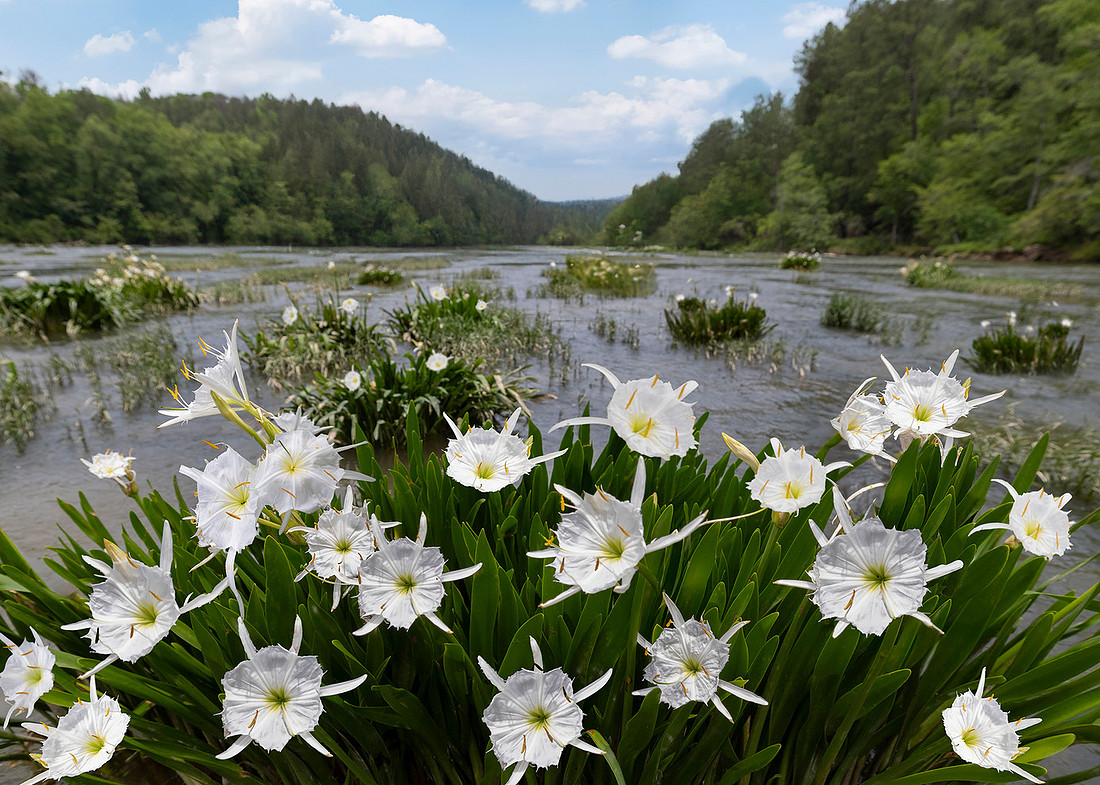

Cahaba Lilies
My fascination with flowers, a passion inherited from my mother, led me on an unforgettable quest in May of 2025. My goal: to find and photograph the elusive Hymenocallis coronaria, a rare aquatic flower that thrives in the swift, shallow rivers of the Southeastern United States. This striking perennial, endemic to Alabama, Georgia and South Carolina, is often called the Shoal Lily, however in Alabama it is widely known as the Cahaba Lily. It requires fast-moving water, rocky shoals, and abundant sunlight to survive. Each fragrant blossom lasts for just one day. Tragically, dam construction has decimated its habitat, and today, only around 50 viable populations remain. One of the largest is nestled within Alabama’s Cahaba River National Wildlife Refuge.
Armed with this knowledge and a spirit for adventure, Bill and I packed up our camper van, affectionately dubbed Van Go, and set out for West Blocton, Alabama. Our mission: to find and photograph the Cahaba Lilies blooming at Hargrove Shoals, a section of the Cahaba River located within the refuge. Directions were vague: a dirt road that dead-ended at a blue gate, followed by a crossing of Caffee Creek, and then a mile hike along an unmarked trail.
Caffee Creek presented the first challenge. Its surprising depth, three to four feet, forced me to remove my backpack and wade through the current holding my camera gear above my head.
At the end of the mile long hike, we arrived at Hargrove Shoals and were captivated: thousands of radiant lilies blanketed the river like scattered stars. But between us and the flowers stretched a 40-foot span of water, deceptively still and surprisingly deep. Bill, at 6’2”, waded in and quickly confirmed it was well over his head. Swimming across with camera gear wasn’t an option. So, back we went; through the woods, across the creek, and out of the refuge.
As dusk settled, we found a solution in the most unlikely place: Walmart. For $35, we bought a rubber boat.
We returned to the refuge at dawn. We inflated the boat and hiked back through the forest with Bill carrying the boat and me carrying the camera gear. Once more, we reached Hargrove Shoals. I loaded the gear into the boat, and at Bill’s suggestion, climbed in as well. With quiet resolve, he slipped into the water and began swimming across, pulling me and the boat behind.
We finally reached the lilies and it was magical; thousands of white blossoms danced in the rushing current, their sunlit, white petals glowing against the dark rocks beneath. But the shoals were perilous. Slippery stones and unexpected holes made every step treacherous. We quickly learned to use the boat as a floating workstation, keeping the camera securely stowed until needed for a shot. Bill and I walked or swam alongside the boat, carefully guiding it through deeper, swifter channels. Upon reaching a rocky shoal, I would climb up, tripod in hand, soaked yet resolute.
Once among the lilies, the real work began. I moved cautiously, scanning for the perfect composition. I photographed upstream, where the river surged toward me, and downstream, where the lilies receded into the distance. Every frame deepened my joy. Though breathtaking, I sensed I had missed peak bloom by about a week; some green leaves showed signs of fading, and many blooms had already fallen. This only fueled my resolve, and I knew I would return again next year, closer to the height of their glory.
Then came the low rumble of thunder.
Knowing that our return across the shoals, the deep river channel, the forest trail, and Caffee Creek would take time, we packed up quickly. As we reached Van Go, the storm broke, rain cascading over the windshield as we drove out of the refuge.
Every detail - the research, the early morning chill, the physical obstacles, the improvisation, Bill’s unwavering support, and the drama of the weather all worked together to form the narrative behind the final image. The final product is more than a photograph. It is a symphony of circumstance, effort, and determination.
But this journey offered more than beauty and adventure. It offered a lesson.
The Cahaba Lily blooms in wild, rushing water; its delicate elegance forged in the very turbulence that threatens its survival. Its beauty is not in spite of the current, but because of it. That paradox struck me. How often is this true for people as well?
True beauty and resilience often flowers in life’s swiftest currents, amid adversity, uncertainty, and challenge. Like the lily rooted in slippery shoals, people who endure life’s trials often emerge with strength, wisdom, and beauty shaped by their struggles. Their hardships don’t obscure their brilliance—they reveal it.
In the end, the Cahaba Lily is more than a rare flower; it’s a metaphor. A symbol of the fragile, fierce beauty that blooms not where the water is calm, but where it races over jagged rocks, in the shallow, churning turbulence of life’s shoals.
|
January
February
March
April
May
June
(1)
July (1)
(1)
August (1)
September
October
November
December
|
January
February
March
April
May
June
July
August
September
October
November
December
|
January
February
March
April
May
June
July
August
September
October
November
December
|
January
February
March
April
May
June
July
August
September
October
November
December
|
January
February
March
April
May
June
July
August
September
October
November
December
|
(1)
January (1)
February
March
April
May
(1)
June (1)
July
August
September
October
November
December
|
(1)
January (1)
February
March
April
May
(1)
June (1)
July
August
(1)
September (1)
(2)
October (2)
November
(1)
December (1)
|
January
(1)
February (1)
March
(1)
April (1)
(6)
May (6)
(1)
June (1)
July
August
September
October
(1)
November (1)
(1)
December (1)
|
(1)
January (1)
February
March
April
(1)
May (1)
(1)
June (1)
(1)
July (1)
(1)
August (1)
September
October
November
December
|
- Home
- About Audrey
-
Portfolio
►
- Galleries
- My Favorites
- Landscapes & Cityscapes
- Madison
- Georgia Tech Grads 2017
- Tessa Joy
- Tidwell/Henson Wedding
- Kaylee & Tim's Engagement
- Kaylee & Tim's Wedding
- Alicia and Mike's Wedding
- Lily and Chris' Wedding
- Georgia Tech Graduates
- Tori
- Kelly & Jeff's Wedding
- Bekah
- Hunter
- CHS Gymnastics
- Gate Key Scholars
- Best Friends
- Cartersville Seniors
- Johann & Isabella
- Melissa & Pat's Wedding
- Savannah's GT Graduation
- Macro
- Atlanta Sunset
- Brandon and Meagan
- Karli Q
- GT Origins of Life Lab
- Kate & Owen's Wedding
- Devyn
- Andrea's PhD
- Georgia Tech Engagement
- Wimbish House Wedding
- Occasional Words
- Great Smoky Mountains
- Contact Me