
On Jake's 32nd Birthday

For Jake on his 32nd Birthday
I taught Jake how to swim when he was three years old.
With a little toy fish and a plastic, yellow boat clutched in his small hands, he spent that summer eager for every visit to our apartment’s pool in Jackson, Mississippi. When he first learned, he bypassed swimming on top of the water altogether, choosing instead to move entirely underwater. He kept both arms pressed firmly against his sides, relying entirely on his legs to kick and propel himself. It was unusual, but he was comfortable, confident, and totally in his element.
By the summer he was six, Jake and his sister, Savannah, were taking swimming lessons at the Dellinger Park pool in Cartersville, Georgia. By then, they were both excellent swimmers. On the last day of their class, their teacher gathered all ten students at the deep end of the pool.
The challenge was simple: everyone would tread water, and whoever lasted the longest would win a prize.
Within thirty seconds, most of the children had given up and swam to the side to hold on. Soon there were only two kids left in the deep end.
Jake and Savannah.
Five minutes passed. Then ten. Neither one would quit.
They looked as though they could have stayed out there all day, smiling and laughing while still treading water. Eventually, time ran out, forcing the teacher to intervene, stop them simultaneously, and award them both a prize. That was the only way to make them surrender.
I saw that same determination years later when Jake was on the Cartersville High School swim team. By then he stood six feet, one inch tall with a broad upper body and a wide wingspan. He possessed the ideal build for the butterfly. Though he could swim all four strokes, he was often assigned to the butterfly events because he was good at them, and few others had the desire to tackle such a challenging stroke.
At his final swim meet as a high school senior, he was in heat 1 of the 100 yard Butterfly. I stood at the end of his lane, trying to photograph him as he approached. I wanted the shot of him rising out of the water, arms extended wide in the distinctive rhythm of the butterfly. It was not easy.
I was still relatively new to photography back then, shooting with a Nikon D90 rather than the Canon mirrorless I use today. The subject-tracking technology I rely on now did not even exist then.
As Jake came toward me, his head went up, then down, and water splashed everywhere. Each time I thought I had the focus locked, another splash interfered.
But on his second-to-last stroke before reaching the wall, I got it!
His arms were spread wide. His body was rising from the water. It was his last swim team event of high school, and I had captured it!
My Jake.
He has always had that kind of drive - a trait both of my children share when tackling new sports. They took to skiing, snowboarding, and backcountry skiing with enthusiasm. Jake even ran cross-country in high school, despite being a tall, broad-shouldered swimmer who was not built for distance running. He has always been determined when something captures his interest.
The important part, I have learned, is that it has to be something he cares about. Once it is, he goes all in.
I saw that familiar quality again recently when Bill and I drove across the country to visit Jake in Bellingham, Washington. From there, we traveled together by ferry and camper van to the wild edge of Vancouver Island in Tofino. That was where Jake introduced us to his newest passion.
Foiling.
I had never even heard of “foiling.” Even after Jake explained it and demonstrated, I wasn't sure I understood what I was seeing.
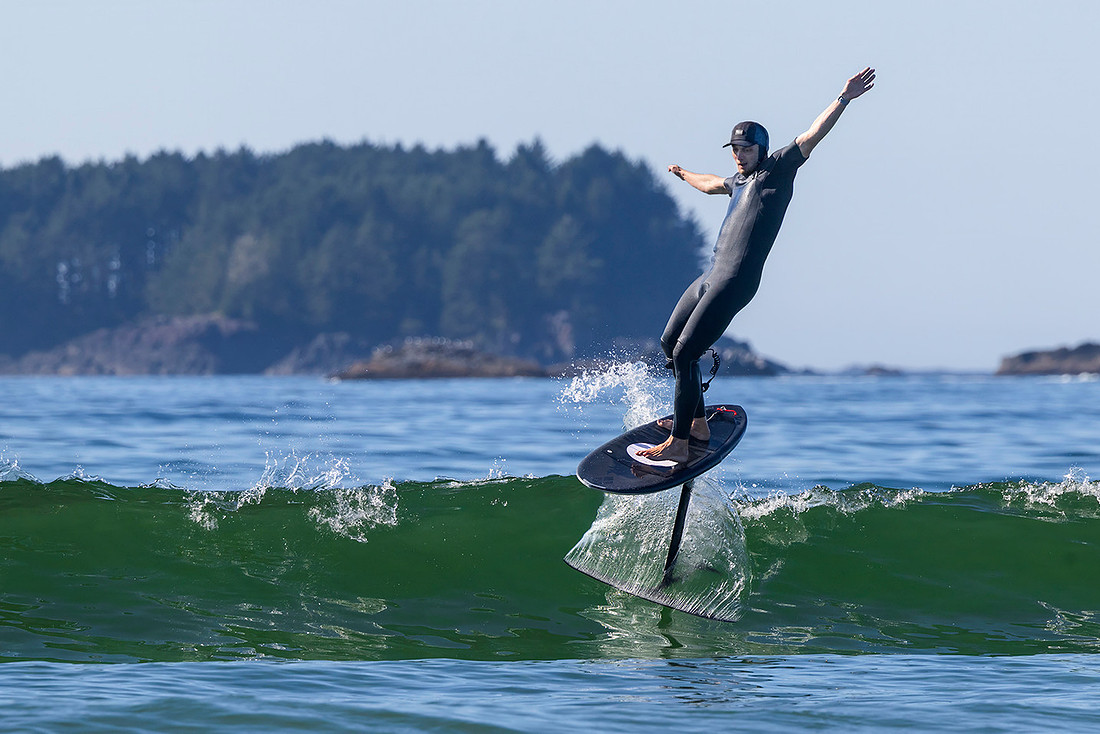
A foil is a hydrofoil attached beneath a board. As the board gains speed, the underwater wing generates lift, raising the board above the ocean's surface. The rider appears to skim over the waves, several feet above the water, supported by a narrow mast with the wing hidden beneath the swells. Unlike ordinary surfing, foiling allows a rider to glide beyond the breaking part of a wave and, with enough skill, connect with another swell without getting off the board.
Jake was eager to get out on the water the moment we reached Tofino on Wednesday afternoon. Despite the cool weather, he zipped up his wetsuit and headed straight for the surf even though daylight was fading fast.
Watching from the shoreline, I squinted toward the wild Pacific, trying to figure out the mechanics of what I was seeing.
There were hundreds of surfers scattered across Cox Bay, appearing from a distance as little more than heads rising and falling between the swells, but I could recognize Jake without hesitation. Partly because of his physical posture on the board: while waiting for a swell, he lies prone with his knees bent and feet lifted behind him. I quickly learned to watch for that distinct silhouette against the blue-gray water.
But it was more than his technique that helped find him. It was what I call ‘mother vision.’ After thirty-one years of watching him, I could pick him out in a crowd, even one spread across the ocean.
And over the next five days I watched. Jake spent every free second he had in the ocean waiting for just the right swell to arrive.
And when it did, he would paddle hard to get ahead of it, pop up onto the board, and begin to glide. He was not simply riding a single wave all the way in to the beach. He would turn, pump sideways, work his way back toward the open water, and connect to another wave, and then another.
By the end of our stay, he could stay upright until he decided he was ready to stop. He told me that even when he was exhausted, he didn't want to quit.
"A bad run makes me want to try again and do better," he said. "A good run makes me want to try again and see if I can do better still."
I understood that completely. I understood it as his mother, and I understood it as a photographer.
One afternoon, when the water at Cox Bay was flat, Jake checked an app and discovered that conditions were better ten miles south at Long Beach, near Incinerator Rock. He packed up his equipment and headed there.
I packed up my camera and went with him.
Just as I had followed him to swimming pools, watched him compete in the butterfly, and stood on the sidelines of countless other pursuits, I wanted to be there for this too.
Jake is usually camera-shy but this time, he was interested in what I was capturing as a means of evaluating his own form. I was using my Canon R5 Mark II with a 100–500mm lens and a 1.4x teleconverter. The subject tracking technology made it much easier to follow his runs far out in the Pacific. In good light, I could capture him clearly. Under heavy clouds, the images grew noisier. Still, I kept photographing.
He would finish a run, fall, or step off the board to rest, and then head back out.
I would remain on the shoreline, my feet cold, my shoulder beginning to ache, waiting for his next attempt.
Maybe the next run would be better.
Maybe he would make a beautiful turn with the lighthouse behind him.
Maybe the foil would break the surface at exactly the right moment, visible through a glassy aqua wave.
Maybe I would capture something I had never seen before.
I realized that Jake and I were doing much the same thing.
He was returning to the water in search of the next perfect run.
I was raising my camera in search of the next perfect photograph.
Neither of us wanted to quit.
On Sunday morning, before we left, he hurried down to the beach when it was barely light to get one more hour on the water.
And I went too, camera in hand. And I watched him just as I had watched him in the pool in Jackson, tread water in Cartersville, and rise out of the waves during his final high school butterfly.
Though the setting had changed and the little boy was now a grown man living thousands of miles away, something very familiar remained. He still finds something that interests him, gives it his full attention, and keeps going back for more.
And I still find myself watching.
I miss him more than I can easily explain: his very unique brand of humor, his curiosity, his goodness, and the simple pleasure of spending time with my son. But I am grateful that he has built a life that suits him. Bellingham gives him mountains, snow, rivers and ocean. He has found a place where his passions have room to grow. I would rather have him living a life he loves, even far away, than living close by and feeling confined.
The photos will eventually be stored safely on my server under ‘Tofino, September 2026.’ Some will be grainy and noisy from the low light, but that doesn't matter. I love them not for their technical perfection, but for what they hold.
They hold a three-year-old boy kicking underwater in Mississippi.
A six-year-old who refused to stop treading water.
A teenager rising through the spray of his final butterfly.
And now my grown son, out in the Pacific, pursuing the next wave.
So I stand on the shore and watch. And when that perfect wave comes along and Jake pops up onto his foil, I lift my camera again.
I'm still his mother, after all.
And his number-one fan.
Wild Cherries!
Wild cherries!!
In the Great Smoky Mountains National Park, by the first week of August, these sweet, dark berries are fully ripe, and the black bears in Cades Cove love them! They will risk life, limb, and defy basic gravity just to get a mouthful of those sun-ripened delicacies.
Watching this madness unfold is pure joy!
The black bears climb far higher than seems sensible for a creature of their weight, crawling out onto spindly limbs that bend and sway under their bulk. I have seen as many as four bears balanced on a single branch, each singularly focused on getting every last ripe cherry.
So, last Friday my expectations were set for a classic summer day of bear-watching as we made our usual left turn onto Sparks Lane inside Cades Cove.
As we rolled along, we noticed a couple of cars stopped and people looking up into the trees - the classic start of a "bear jam." We pulled up, and I stepped out with my Canon R5 Mark II, 100–500mm lens already in place.
Just before the place where Abrams Creek crosses over Sparks Lane, two cherry trees stood side by side. For fifteen delightful minutes, a handful of us stood together on the dirt road, practically giddy as we watched four bears, a mama and her three cubs, shifting from branch to branch to get at the fruit. There is a shared, childlike excitement that takes over a group of strangers when everyone is looking up in total awe at the bears. One woman near me kept a hawk's eye on her own family, repeatedly calling out to her mother in a mix of panic and fun, "Don't go too close, Mama!" and "Stay close to the car, Mama!"
Then, without making a single sound or call, the mama bear started coming down the trunk tail-first, sliding down just like a giant cat.
The crowd retreated. Mama bear crossed a patch of grass and headed straight toward the tree line. Right behind her, as if responding to a silent cue, all three cubs slid down and ran after her.
As soon as the bears disappeared into the trees, everyone else packed up and headed to their cars. But I stayed put, relying on what I knew about the layout of the Cove.
Abrams Creek runs perpendicular to Sparks Lane, flowing east to west behind a dense wall of trees. The road intersects the water via a paved, shallow ford. I knew the creek was only about 20 yards beyond that tree line where the bears had disappeared. Trusting my gut and what I knew about the terrain, I walked over to the ford, pulled off my hiking boots and socks, and stepped right into Abrams Creek.
The water was shockingly cold and about six inches deep right in the middle of the submerged road. The algae on the concrete was as slick as ice, so I had to tread carefully, but I made my way to the center of the creek, turned west, and looked down the tree-lined stream.
And just like that, it happened.
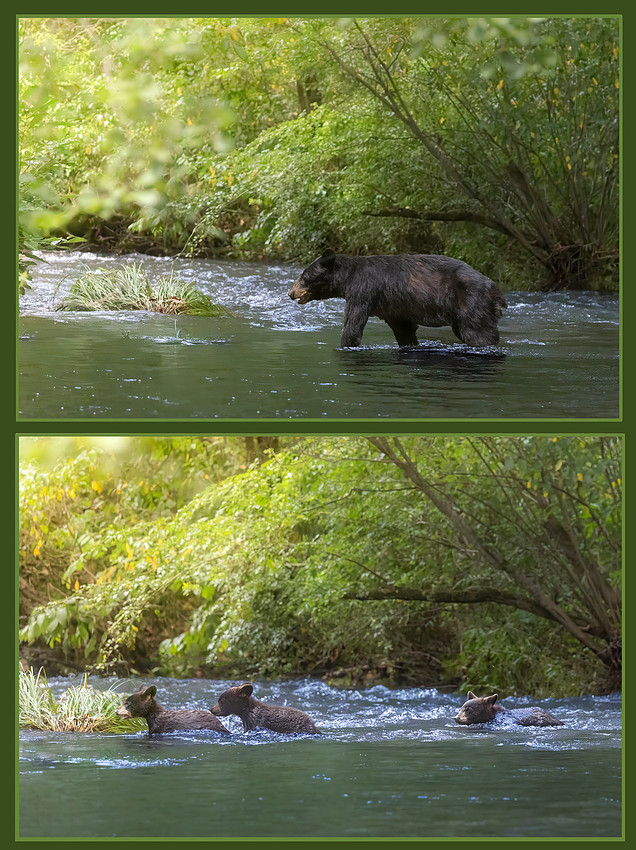
About 40 yards downstream, mama bear stepped out of the brush and directly into Abrams Creek. Then, about 10 seconds later, came the three cubs, jumping in one after another and paddling in a tight single-file line. At their entry point, the current was strong and the water was over the cubs' heads, forcing them to swim hard until they reached a shallow, grassy area in the middle of the stream.
The whole crossing took 30 seconds max. In the sheer excitement of the moment, I did not have the presence of mind, or the time, to switch to video or adjust my settings. I just framed the shot and held down the shutter. I was shooting at a 1/2500-second shutter speed under a dark canopy, which pushed my ISO high and left me with plenty of noise in their black fur to fight in post-processing.
Just a few minutes earlier, everyone else had packed up and driven away, assuming that the bear family had retreated from easy view. But standing barefoot in the middle of Abrams Creek, I was just glad I followed my hopeful hunch.
I ended up with icy feet and a few editing headaches for later, but watching that mother lead her three cubs across the water was worth every second. It was simple, quiet, and completely real. I know I will never forget standing there, barefoot in Abrams Creek, watching that little family make its way across the water.
Billiee's China
Billiee’s China
The table was magnificent. I had set it meticulously, hoping the setting would elevate the evening’s purpose. A sage tablecloth stretched smooth beneath crystal candleholders, their soft glow falling over white napkins folded like Christmas trees. Silver reindeer rested atop each one, holding delicately scripted place cards. Savannah and Tommy, along with our dear friends Karen, Kent, and Kris all arrived for an early Christmas celebration. Laughter, comfort, and the clink of glasses combined to make the evening feel warm and easy.
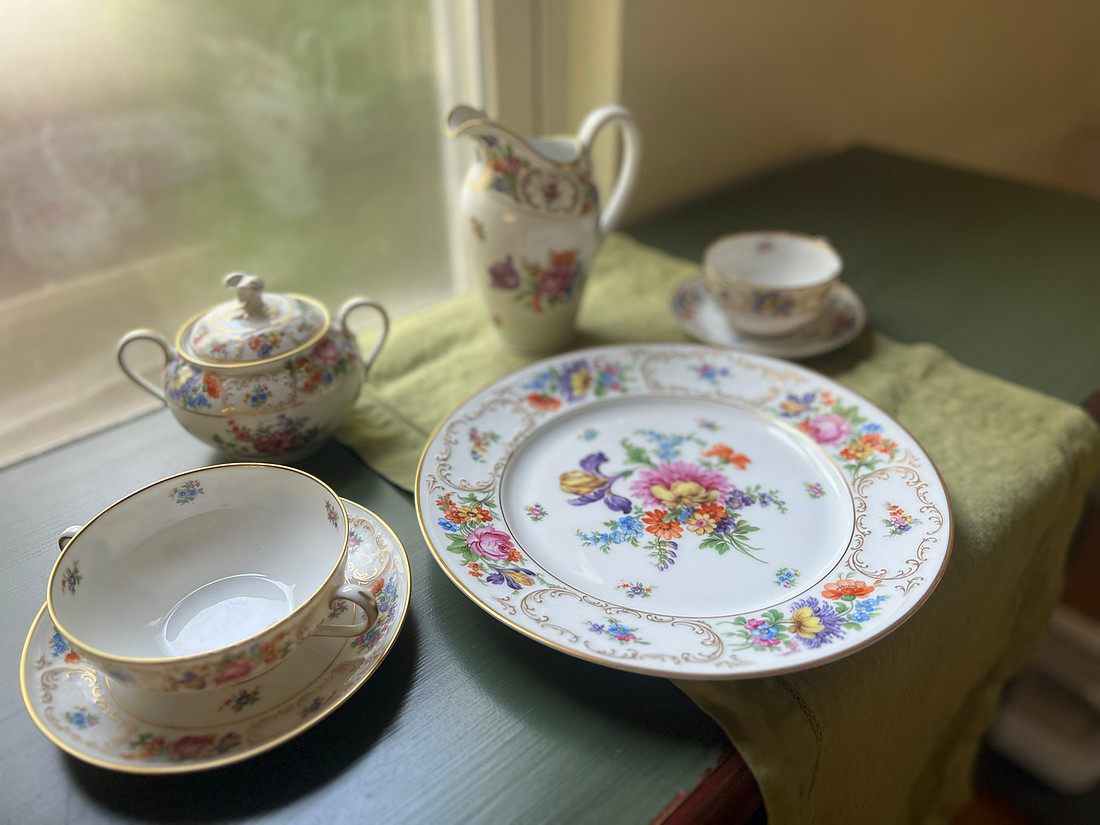
I couldn't stop looking at the china, gold-rimmed porcelain with vibrant floral patterns. I carefully fit the platter and gravy boat onto the table, making sure not to crowd the setting. I even added that small, curious pitcher, though I still wasn't sure what it was for. My heart raced as I finished. I couldn't wait to give Savannah this special Christmas surprise.
We blessed the food. Forks hovered over ham, cranberry salad, mashed potatoes, and sweet potato soufflé. Then Savannah looked down and paused.
“Mom,” she said, tilting the bread plate to catch the light. “This china is beautiful. Is it yours?”
This was the moment I had been waiting for.
“No,” I said. “It was Billiee’s. And now…it is yours.”
The table fell silent. Savannah’s surprise came first, followed by unmistakable delight. Her reaction told me what I had hoped to learn. In that moment, the room held the weight of a legacy that had finally found its way home.
Long before the china was rescued, boxed, purchased, and set at my Christmas table, there was Billiee Pendleton-Parker.
Savannah was only seventeen when she left home for Georgia Tech. “Launching” a child comes with an unexpected sadness. I had sent my firstborn into the world with nothing but my prayers and the compass of her own integrity to guide her. My sadness eased slightly when Billiee Pendleton-Parker, the Assistant Director of the President’s Scholarship Program, stepped into our lives. BPP, as she was known, quickly became my greatest source of comfort.
Billiee didn’t just look after Savannah; she loved her. And two years later, when Jake arrived as a President’s Scholar as well, she folded him into her heart with equal devotion. She became a safety net beneath the pressure cooker of Georgia Tech, serving as a surrogate mother and a wise counselor. She was the “softer side” of a place that demanded excellence from students barely out of childhood.
Her oversized heart, fashioned from pure white and old gold, possessed a quiet radar for students in need. She told them again and again: “Strive for significance, not success.” And they believed her, because she embodied it.
By the time Jake arrived, Parkinson’s had taken Billiee’s ability to drive. So Savannah, Jake, and dozens of President’s Scholars created the legendary ‘Driving Miss Billiee’ spreadsheet and took turns chauffeuring her to campus each morning and back home each evening. When she couldn’t step into Savannah or Jake’s SUVs, they learned to navigate the narrow alley behind the Student Success Center, easing their vehicles close to the steps so she could enter with dignity. It was everyday kindness, small acts, repeated faithfully, that shaped them more than any class ever could.
In 2015, as Billiee’s health declined, she retired and prepared to move from her three-level Druid Hills condo into a small assisted-living apartment. I volunteered to help with the process of packing her belongings and deciding what she would take with her.
Her home held a lifetime of possessions, treasured heirlooms passed down through generations of the Pendleton family in Western North Carolina. Every box, drawer, closet, and cabinet had to be opened and sorted, each decision shaped by what could fit into a much smaller space and what would have to be released through an estate sale. The work stretched across weeks. Somewhere in that whirlwind sat a large set of fine china, passed down from her North Carolina family. In my exhaustion, I barely noticed it.
But RoseMary Wells did.
RoseMary was also retired from Georgia Tech and had volunteered to help me in the monumental task of helping Billiee.
She recognized the china’s beauty, its age, its value, and its sentiment. She refused to allow the china to be lost, generously purchasing it herself and packing each piece with care. For the next decade, the china stayed safely in her home, waiting for the right moment, for the right hands.
Over the years, RoseMary and I tried many times to reconnect about passing the china to Savannah. After Billiee’s death, a painful loss for my children, my conversations with RoseMary became less frequent. Life stayed busy, and despite good intentions, we never connected to meet until the summer of 2025.
On a Tuesday in late August of 2025, I drove to Atlanta and spent an entire day with RoseMary, lifting each piece from her cabinet and wrapping it carefully. The china was beautiful, looking just as it must have a century ago: Dresden-style, early 1900s, white porcelain with bright florals that danced beneath delicate gold rims. We talked all day, sharing memories of BPP as I filled four large boxes.
On the drive home, my thoughts stayed with Billiee as I remembered her kindness, her endearing quirks, and her gentle way of shaping souls. I hoped Savannah would love the china. I hoped she would feel the meaning behind it.
And then, in early December, as I sat across from Savannah and saw her smile, I knew she did.
After dinner, she and Tommy stayed late, washing and drying each piece as if handling something sacred. She kept turning plates in the light, admiring the flowers, the gilded details, the blend of history and celebration. Though Savannah was now stepping into her role as the steward of this treasure, the four massive boxes stayed tucked away in my dining room for the night.
The next morning, before I was even awake, she texted:
“Mom, can you send me photos of the markings on the bottom of the china? I want to research the pattern!”
She had already fallen in love.
When we talked, we both said it in unison: “Billiee would be so, so happy.”
This china, a treasured heirloom, had traveled far. Now it was being passed to someone who loved Billiee and was loved by her in return.
It is the quiet continuation of Billiee’s way of living, rooted in her belief that significance is earned not by what you own, but by how you love. Her china will now gather Savannah’s friends around a table, invite conversation, nourish community, and hold beauty without pretense - the enduring hallmarks of Billiee’s life.
And as I watched Savannah cradle a saucer in her hands that night, her smile soft, her eyes bright, I realized this dinner wasn’t about dishes at all.
It was about a woman whose kindness outlived her.
It was about a legacy finding new life.
It was about love, handed down, wrapped in paper, carried home, set carefully at a Christmas table inviting Billiee’s warmth to every table Savannah will set.
Namibia in Fifty Observations
Namibia in Fifty Observations
1. Cheetahs meow.
Not "sort of" like house cats.
Exactly like house cats!
2. Rhinos are surprisingly chill. Hippos are not.
3. Hippos are among the most dangerous animals in Africa.
This is very important to know because,
They look kind of friendly, like oversized water balloons.
4. The tallest sand dunes in the world are even bigger than they look in photographs.
5. Sand dunes meeting the Atlantic Ocean looks like nature at its most dramatic, creating a breathtaking border where the ancient desert meets the immense sea.
6. Water is precious here.
You understand that very quickly.
7. Coming from the humid American South, the single-digit desert humidity actively strips moisture from your skin. Every bathroom sink has a bottle of pump lotion for this exact reason, and I used it constantly.
8. I spent fourteen days in Namibia and saw exactly one piece of litter.
It was an Orange Crush bottle on the sidewalk in Windhoek.
I remember it because it was unusual.
9. Public restrooms are astonishingly clean.
Some require three Namibian dollars to enter.
This seems like a bargain because that is only about .30 cent usd.
10. Putting a five-dollar coin into a three-dollar restroom turnstile is not recommended.
Trust me.
11. I ordered French Toast for breakfast in Keetmanshoop. What I got was a piece of wheat toast with an egg, tomato and cheese on top. It was pretty good - especially the tomato.
12. The cleanest grocery store I have ever visited is a Super Spar in Walvis Bay.
I was not expecting Namibia to win in that category.
13. The steering wheel is on the right side of the vehicle.
The vehicle drives on the left side of the road.
Your brain eventually adapts.
14. Good company makes six hours on a washboard dirt road much more tolerable.
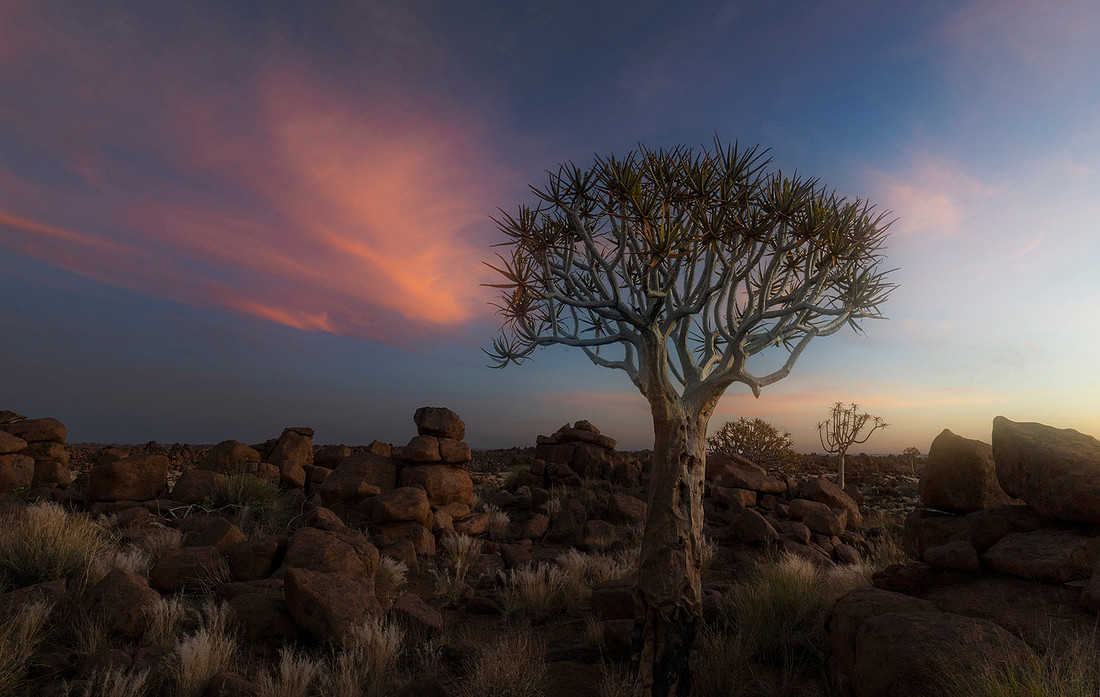
15. Quiver trees are not actually trees.
They're giant aloe plants.
People once used their branches and trunks to make quivers for arrows.
Hence the name.
16. I emptied what seemed like a pint of sand from my shoes each night. Weeks later and back home in Georgia, I swear I can still feel the desert in my hiking boots.
17. Jackals look like friendly dogs with oversized ears.
Nonetheless, do not try to pet them.
18. Giraffes approach a waterhole with extreme caution and zero grace. Because lowering their heads requires a precarious, wide-legged stance, they look utterly defenseless and entirely out of their comfort zone. In order to drink, they must practically do a split.
19. Zebras are the comic relief of the Savanna.
They are also remarkably curious and photogenic.
20. There are two kinds of zebra in Namibia.
Plains Zebra and Mountain Zebra.
The stripes on the Mountain Zebra go all the way down it’s legs.
I think they are both beautiful.
21. Elephants are enormous.
They are also somehow capable of disappearing behind minimal vegetation.
22. I touched an elephant named Millie.
She felt rough and covered in coarse hair.
Nothing about the experience matched my expectations.
23. Flamingos spend most of the time with their heads down.
That is frustrating for a photographer.
24. There are many surprises in the town of Walvis Bay. For example, the streets are made of salt and there is a pink lake!
I did not know that salt roads and pink lakes were a thing.
25. Seals can leap out of the water with surprising athleticism.
26. A Lilac Breasted Roller bird doesn't just fly from tree to tree; it puts on a clinic in aerial acrobatics, twisting and rolling the entire way.
27. Instead of diving from the sky, the secretary bird hunts snakes and lizards on the ground, killing them by stomping on them with a force five times its own body weight in a fraction of a second.
28. There are approximately 2500 elephants in Etosha National Park.
I saw somewhere between 60 - 80 of them all at once gathered around a water hole.
29. The night skies are stunning.
Outside Windhoek, real darkness still exists.
The kind of darkness that allows stars to show off.
30. Champagne on top of a giant dune overlooking the Atlantic Ocean is a memory.
So is sipping a mimosa at sunrise at the lighthouse in Walvis Bay.
31. There are many deadly snakes in Namibia.
I saw none of them.
For this, I remain deeply grateful.
32. Understanding the exchange rate is important. Local tipping customs differ from the US; a standard and fair tip for a bag carrier is $50 NAD, which translates to about $3 USD. Using the currency conversion feature on your calculator helps you tip confidently and respectfully.
33. Before traveling to Namibia go online and buy an E-visa for roughly $100 US. It will still take a very long time to go through customs when you arrive at the Windhoek Airport.
34. The best omelette I have ever tasted was made by a woman in the town of Luderitz!
35. A “Dune Drop” in a 4x4 in Sandwich Harbor is a thrill!
36. Many restaurants and resorts in Namibia cook and serve bush meat (oryx, kudu, springbok).
37. Walking through the ghost town of Kolmanshoop feels like discovering a secret world frozen in time. Abandoned by the Germans in 1956 when the diamonds ran out, this old mining settlement outside Lüderitz is slowly being devoured by the sand. The way the desert wind forces its way inside, filling old bedrooms and hallways with massive, perfect dunes, makes it an unforgettable landscape.
38.The accommodations, the dining experience, and the ambiance at Dead Valley Lodge are the definition of desert luxury. It isn't opulent or flashy; instead, it offers a quiet, understated elegance that feels simple, relaxing, and perfectly tuned to the wilderness around it.
39. One of those details that catches you off guard: in the Southern Hemisphere, the sun tracks through the northern sky on its way from east to west.
40. Namibia is roughly twice the size as the state of Montana. It has a population of 3.3 million people. It has one of the lowest population densities in the world.
41. Before entering Etosha National Park, you car will be inspected to confirm that you do not have any plastic bags or raw meat.
42. Tips for photographers in Namibia - don’t change lenses in or near the desert and/or dunes. Bring two camera bodies. Carry drinking water. Afternoon heat haze will frustrate you and make your photos look unsharp if using a long lens. Picaridin is the bug repellant you should use; if bug spray contains deet, it could come in contact with your camera gear and ruin it.
43. Giraffes will not approach the watering hole if elephants are there. Springbok and Wildebeest will.
44. You can buy an eSim after you arrive in Namibia. None of the US cell carriers will work there, even if they say they do. Go to see Nancy at the MTC store in the Windhoek Airport. She will set you up with an eSim. Tell her that Edwin sent you.
45. Leopards, like hippos, deserve your full respect.
Neither one should be underestimated.
46. In Namibia, the seasons are reversed from the Northern Hemisphere. Traveling during our summer means arriving at the beginning of the Namibian winter. Even so Namibian winter days are still hot and extremely dry, but the nights can drop to a chilly 45°F.
47. In Etosha National Park the rules state that you CANNOT get out of your car for any reason other than a flat tire. Apparently having a fender bender is also an acceptable reason.
48. In Deadvlei, time seems to have stopped completely. The iconic camel thorn trees standing in the white clay pan have been dead for nine centuries, but the lack of humidity prevents them from rotting. They don't decompose; they just stand there, scorched by the sun, defying the ages.
49. The flight from Johannesburg to Atlanta is 17 hours long. I passed that time by reflecting on this wonderful trip and writing down these observations.
50. I have come to realize that I am not really a photographer.
I am simply a curious and grateful person who happens to have a camera.
My lens is simply how I share the beauty that has already been painted for us. I hope to produce images that invite others to look closely and appreciate God’s creation.
After a experience like this I feel kind of obligated to end the trip with a profound life lesson.
But I don't really have one.
Namibia did not reveal the meaning of life.
It did not transform me into a new person.
What it did do was give me fourteen uninterrupted days to pay attention.
To wildlife.
To landscapes.
To friendship.
To silence.
To stars.
To sunsets.
To a place unlike anywhere I had ever been.
To God’s perfect creation.
And I think that's enough.
Actually, I think that's everything.
Patagonia
Patagonia
The blue of glacier ice does not look real. It is not the familiar blue of sky or water, but something brighter, cleaner, almost electric. Standing before the Viedma Glacier, I caught myself staring at that radiant blue.
I’ve heard it said that in heaven we will see colors our eyes have never seen before. Looking at that ice, I wondered if this might be a preview.
But the brilliant blue of the glaciers was a long way from my first impression of Patagonia.
At first glance, the pampas felt almost lifeless. It is a vast, flat landscape where the horizon stretches endlessly in every direction and trees are scarce. We drove for hours from Punta Arenas, Chile to El Chalten, Argentina, seeing mostly open land and the occasional rhea, caracara, or guanaco moving through the scrubland. It would be easy to call it desolate and move on.
But photography has a way of slowing me down and correcting my vision.
The longer I looked, the more Patagonia revealed itself. As we approached the Fitz Roy Massif in El Chaltén, and later the Cuernos del Paine in Chile, the landscape gradually began to change. Flat plains gave way to rolling hills, and the endless tans slowly shifted into yellows, golds, browns, and the deep maroons of lenga trees in late autumn. Lakes reflected soft turquoise tones. Dead, twisted trees bleached by time and wind stood like ghostly sculptures.
The more time I spent there, the more detail seemed to emerge from the landscape.
Some of what I saw required effort.
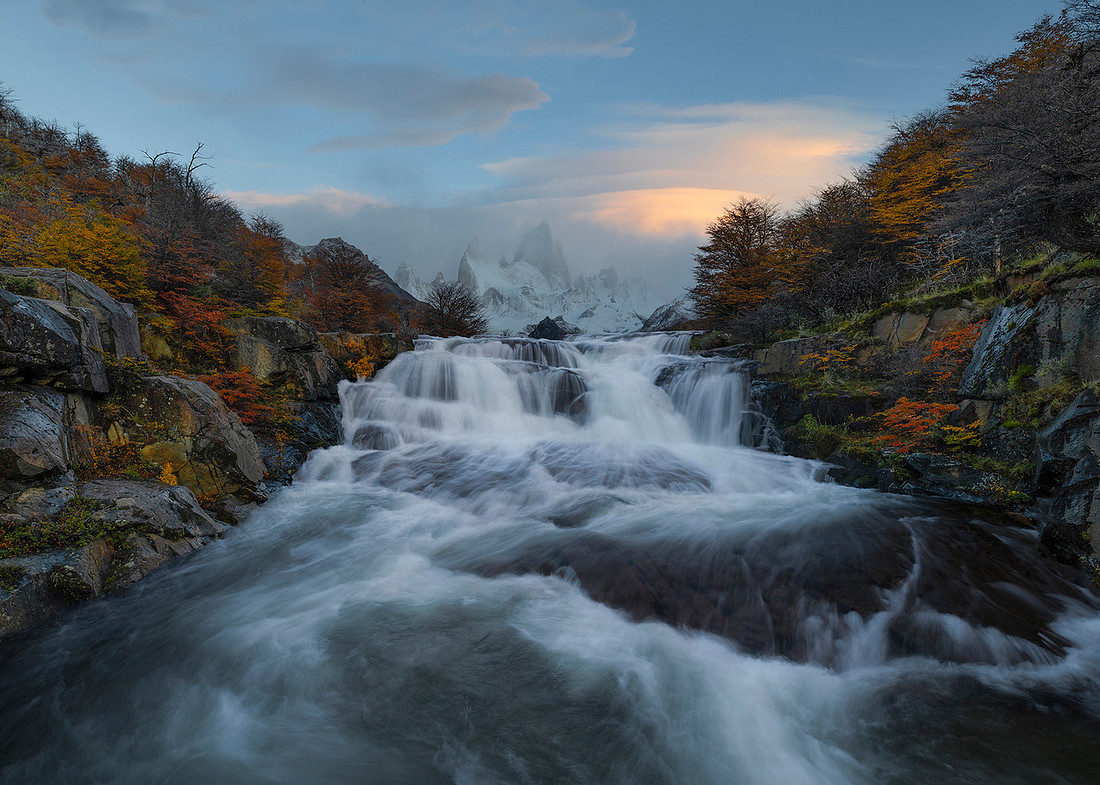
On our second morning in El Chaltén, Francis, Kiki, and I left at 4:00 a.m., hiking through darkness and light rain toward a place without a marked trail. We were not headed to the more familiar ‘Hidden Falls.’ We were instead searching for an unnamed cascade that few people ever visit. Even for Francis, who had been there before, the cascade was not easy to find.
We finally reached the place that I now affectionally call “St. Francisco Cascade.” In waders, we navigated the current to a rock barely large enough for the three of us. Shivering, we set up our tripods and waited.
Dawn approached and the clouds slowly began to move. Right on cue, Fitz Roy revealed itself! Aguja Poincenot stood nearby, equally dramatic against the morning sky.
Then snowflakes began to fall.
We were wet. Cold. Tired.
None of that mattered.
Moments like that reset everything for me. Suddenly, the miles, mud, heavy packs, and relentless winds all feel worthwhile.
We spent nearly two weeks exploring Patagonia. From El Chaltén to El Calafate and Perito Moreno Glacier, then back into Chile and Torres del Paine. We photographed reflections at a still pond below the Explora on a rare windless morning. We slogged through deep mud, stood in unbelievably strong winds, and watched light come and go across magnificent mountains.
Along the way, smaller moments stayed with me as much as the grand landscapes: A fox appearing unexpectedly at the border. Looking up to see the Milky Way arching over the Cuernos. A piece of salmon cooked over a fire that tasted better than any meal I’ve ever had. And the camaraderie of friends sharing the same miles.
Each morning began with a prayer of gratitude for the chance to be there at all. I thought often of my dad and how much he would have loved these snow covered peaks. I looked forward to telling my mom about my sighting of the Long-tailed Meadowlark pair at Salto Grande. I took every step with gratitude, reflecting on how much both of my parents sacrificed to give me these opportunities. And each night ended the same way, with a prayer of thanks that our group remained safe.
By the end of the trip, I understood something more clearly than when I started.
Patagonia is not loud, and it is not easy. It does not hand you its beauty immediately. But if you are willing to slow down, look carefully, and work for it, the landscape begins to reveal something deeper.
This creation—tucked away at "The End of the World"—the mountains, glaciers, winds, and light all felt like gifts, and photography became my way of saying thank you. I left carrying far more than photographs, returning instead with a sense of wonder and a deep appreciation for the privilege of standing in such a place.
My role is to witness it and share it.
I want my images to show others the grandeur of Patagonia. I want to share the dramatic peaks of Los Glaciares and the Cuernos del Paine, alongside the quieter moments: a fox appearing against golden fall foliage at the border, the impossible stillness of a reflecting pond, and that heavenly blue glacier ice.
If I can help someone else see the hand of the Creator in places like these, then the mud and the miles were worth every step. Every 4:00 a.m. start and every heavy pack becomes a small price to pay for the chance to share a little of the wonder I was fortunate enough to find.