
- Home
- About Audrey
-
Portfolio▼
- Galleries
- My Favorites
- Landscapes & Cityscapes
- Madison
- Georgia Tech Grads 2017
- Tessa Joy
- Tidwell/Henson Wedding
- Kaylee & Tim's Engagement
- Kaylee & Tim's Wedding
- Alicia and Mike's Wedding
- Lily and Chris' Wedding
- Georgia Tech Graduates
- Tori
- Kelly & Jeff's Wedding
- Bekah
- Hunter
- CHS Gymnastics
- Gate Key Scholars
- Best Friends
- Cartersville Seniors
- Johann & Isabella
- Melissa & Pat's Wedding
- Savannah's GT Graduation
- Macro
- Atlanta Sunset
- Brandon and Meagan
- Karli Q
- GT Origins of Life Lab
- Kate & Owen's Wedding
- Devyn
- Andrea's PhD
- Georgia Tech Engagement
- Wimbish House Wedding
- Occasional Words
- Great Smoky Mountains
- Contact Me
Patagonia

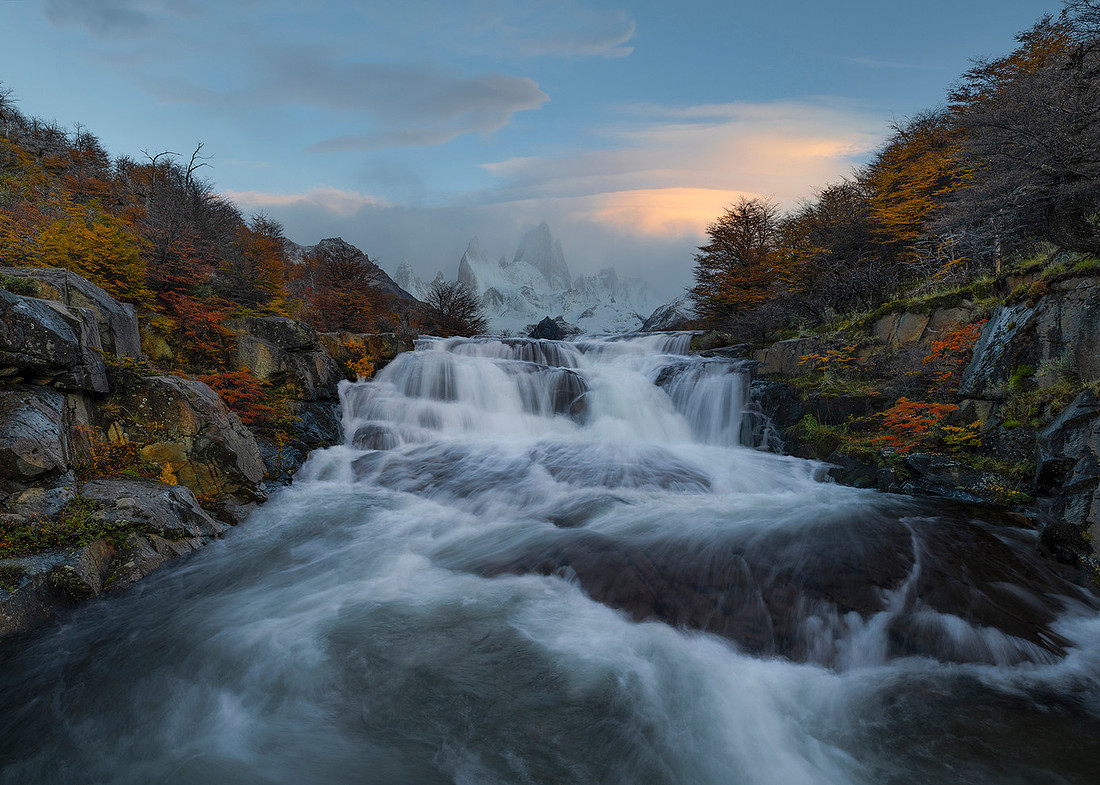 St. Francisco Falls
Patagonia
The blue of glacier ice does not look real. It is not the familiar blue of sky or water, but something brighter, cleaner, almost electric. Standing before the Viedma Glacier, I caught myself staring at that radiant blue.
I’ve heard it said that in heaven we will see colors our eyes have never seen before. Looking at that ice, I wondered if this might be a preview.
But the brilliant blue of the glaciers was a long way from my first impression of Patagonia.
At first glance, the pampas felt almost lifeless. It is a vast, flat landscape where the horizon stretches endlessly in every direction and trees are scarce. We drove for hours from Punta Arenas, Chile to El Chalten, Argentina, seeing mostly open land and the occasional rhea, caracara, or guanaco moving through the scrubland. It would be easy to call it desolate and move on.
But photography has a way of slowing me down and correcting my vision.
The longer I looked, the more Patagonia revealed itself. As we approached the Fitz Roy Massif in El Chaltén, and later the Cuernos del Paine in Chile, the landscape gradually began to change. Flat plains gave way to rolling hills, and the endless tans slowly shifted into yellows, golds, browns, and the deep maroons of lenga trees in late autumn. Lakes reflected soft turquoise tones. Dead, twisted trees bleached by time and wind stood like ghostly sculptures.
The more time I spent there, the more detail seemed to emerge from the landscape.
Some of what I saw required effort.
On our second morning in El Chaltén, Francis, Kiki, and I left at 4:00 a.m., hiking through darkness and light rain toward a place without a marked trail. We were not headed to the more familiar ‘Hidden Falls.’ We were instead searching for an unnamed cascade that few people ever visit. Even for Francis, who had been there before, the cascade was not easy to find.
We finally reached the place that I now affectionally call “St. Francisco Cascade.” In waders, we navigated the current to a rock barely large enough for the three of us. Shivering, we set up our tripods and waited.
Dawn approached and the clouds slowly began to move. Right on cue, Fitz Roy revealed itself! Aguja Poincenot stood nearby, equally dramatic against the morning sky.
Then snowflakes began to fall.
We were wet. Cold. Tired.
None of that mattered.
Moments like that reset everything for me. Suddenly, the miles, mud, heavy packs, and relentless winds all feel worthwhile.
We spent nearly two weeks exploring Patagonia. From El Chaltén to El Calafate and Perito Moreno Glacier, then back into Chile and Torres del Paine. We photographed reflections at a still pond below the Explora on a rare windless morning. We slogged through deep mud, stood in unbelievably strong winds, and watched light come and go across magnificent mountains.
Along the way, smaller moments stayed with me as much as the grand landscapes: A fox appearing unexpectedly at the border. Looking up to see the Milky Way arching over the Cuernos. A piece of salmon cooked over a fire that tasted better than any meal I’ve ever had. And the camaraderie of friends sharing the same miles.
Each morning began with a prayer of gratitude for the chance to be there at all. I thought often of my dad and how much he would have loved these snow covered peaks. I looked forward to telling my mom about my sighting of the Long-tailed Meadowlark pair at Salto Grande. I took every step with gratitude, reflecting on how much both of my parents sacrificed to give me these opportunities. And each night ended the same way, with a prayer of thanks that our group remained safe.
By the end of the trip, I understood something more clearly than when I started.
Patagonia is not loud, and it is not easy. It does not hand you its beauty immediately. But if you are willing to slow down, look carefully, and work for it, the landscape begins to reveal something deeper.
This creation—tucked away at "The End of the World"—the mountains, glaciers, winds, and light all felt like gifts, and photography became my way of saying thank you. I left carrying far more than photographs, returning instead with a sense of wonder and a deep appreciation for the privilege of standing in such a place.
My role is to witness it and share it.
I want my images to show others the grandeur of Patagonia. I want to share the dramatic peaks of Los Glaciares and the Cuernos del Paine, alongside the quieter moments: a fox appearing against golden fall foliage at the border, the impossible stillness of a reflecting pond, and that heavenly blue glacier ice.
If I can help someone else see the hand of the Creator in places like these, then the mud and the miles were worth every step. Every 4:00 a.m. start and every heavy pack becomes a small price to pay for the chance to share a little of the wonder I was fortunate enough to find.
|
January
February
March
April
May
June
(1)
July (1)
(1)
August (1)
September
October
November
December
|
January
February
March
April
May
June
July
August
September
October
November
December
|
January
February
March
April
May
June
July
August
September
October
November
December
|
January
February
March
April
May
June
July
August
September
October
November
December
|
January
February
March
April
May
June
July
August
September
October
November
December
|
(1)
January (1)
February
March
April
May
(1)
June (1)
July
August
September
October
November
December
|
(1)
January (1)
February
March
April
May
(1)
June (1)
July
August
(1)
September (1)
(2)
October (2)
November
(1)
December (1)
|
January
(1)
February (1)
March
(1)
April (1)
(6)
May (6)
(1)
June (1)
July
August
September
October
(1)
November (1)
(1)
December (1)
|
(1)
January (1)
February
March
April
(1)
May (1)
(1)
June (1)
(1)
July (1)
(1)
August (1)
September
October
November
December
|
- Home
- About Audrey
-
Portfolio
►
- Galleries
- My Favorites
- Landscapes & Cityscapes
- Madison
- Georgia Tech Grads 2017
- Tessa Joy
- Tidwell/Henson Wedding
- Kaylee & Tim's Engagement
- Kaylee & Tim's Wedding
- Alicia and Mike's Wedding
- Lily and Chris' Wedding
- Georgia Tech Graduates
- Tori
- Kelly & Jeff's Wedding
- Bekah
- Hunter
- CHS Gymnastics
- Gate Key Scholars
- Best Friends
- Cartersville Seniors
- Johann & Isabella
- Melissa & Pat's Wedding
- Savannah's GT Graduation
- Macro
- Atlanta Sunset
- Brandon and Meagan
- Karli Q
- GT Origins of Life Lab
- Kate & Owen's Wedding
- Devyn
- Andrea's PhD
- Georgia Tech Engagement
- Wimbish House Wedding
- Occasional Words
- Great Smoky Mountains
- Contact Me