
Twenty-Two Words

Twenty-two Words
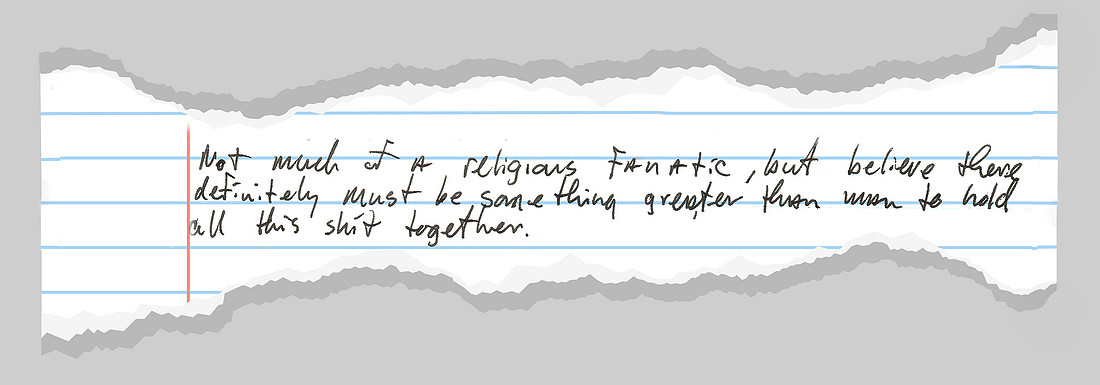
“Not much of a religious fanatic, but believe there definitely must be something greater than man to hold all this shit together.”
One sentence. Twenty-two words, scrawled on the first page of a seven-page letter.
But before that letter ever arrived in my mailbox, a story began with an unexpected meeting on the Georgia coast.
I met Bill on Tybee Island in July of 1988. A group of us gathered at Spanky’s after work, a mix of government and Gulfstream folks grabbing drinks outside, loosening ties, and unwinding at the end of the day. I stepped out onto the patio with my coworker, Jim Ross, who nodded toward two young men sitting together.
“Bill and his brother look just alike, don’t they?” Jim asked.
I had never met either of them, so I shrugged. “Yeah, I guess they do,” I said, and then I grabbed a seat at a table with my Gulfstream colleagues.
In their civilian clothes, the two young officers blended perfectly into the beachside crowd. I wouldn't have noticed them at all had I not seen them pulling bottles of beer from the pockets of their cargo pants. It turned out their military rank carried real responsibility but very little pay. Sneaking their own drinks into the bar wasn't just a prank, it was economics.
Though we didn’t speak that night, we soon became partners in a shared mission: managing the transition of the C-20 Program from Wright-Patterson Air Force Base to Warner Robins Air Logistics Center. After the conference, with Bill in Ohio and me in Georgia, we had frequent work-related phone calls and faxes. As the months wore on, I could feel the tone of our conversations becoming much more relaxed and friendly. We occasionally even talked on the phone outside of work. Then, in November, Bill bypassed the inter-office mail system completely, sending a seven-page letter on lined paper straight to the mailbox at the end of my driveway. Reading his handwriting felt like deciphering an ancient scroll, but I didn’t need a decoder ring to realize he was doing more than just introducing himself. He was auditioning for a role much bigger than ‘colleague.’
And right there on the first page of that letter I read these words:
“Not much of a religious fanatic, but believe there definitely must be something greater than man to hold all this shit together.”
I chuckled at the irreverence of it, shook my head, and kept reading. It was just a single curious sentence in a very long letter; I had no way of knowing then that I would remember those words for the rest of my life.
Bill was charming, intelligent, and relentlessly persuasive. The more we talked over the next few months, the more he insisted that the miles between us were a problem. And that problem was one that he intended to solve. He didn’t simply talk about a future together, he engineered it by personally finding me a job at Wright-Patterson AFB. Though my cautious nature told me to stay put, I eventually gave in to his persistence and headed north. I simply trusted an instinct and took a leap of faith.
My first year in Dayton confirmed that I had made the right choice. It became one of the richest chapters of our lives: long bike rides to Yellow Springs, hikes at Hocking Hills State Park, cross-country skiing on icy neighborhood streets, and even the difficult task of remodeling a bathroom.
A dozen moves in ten short years. From 1989 to 1999 our life was a blur of new zip codes. In the middle of that whirlwind, we made time for what mattered. In February of 1990, we said our “I dos” in a one-room church tucked into the mountains of Tennessee. Before the ceremony, Reverend Clyde Fisher met with us privately and assured us that when he ties a knot, he uses very strong thread and pulls it extra tight.
We welcomed Savannah in St. Louis in 1993, and Jake in Roswell, Georgia, in 1994. I never could have imagined the indescribable joy they would bring into our lives. As we grew into a family of four, our address may have been a moving target, but the foundation we were building was rock solid.
Careers. Babies. Moving vans. Loss. My Daddy died in 1992 and we lost Bill’s father in 1996. We packed our grief alongside Fisher-Price toys and household goods. During those years, Savannah and Jake brought a joy that far outweighed our very real exhaustion. Even when we felt too weary to take another step, the delight of their laughter gave us the strength to keep going. We were tired, but we were happy. Our determination, bolstered by something intangible, held it all together.
But together did not always mean under the same roof. I stepped away from my career to raise our children, while Bill transitioned from the Air Force* to the corporate world. In just fourteen months, we went from 'dual income, no kids' to ‘one income, two kids.’ That shift was a financial strain at first, and while his new career allowed him to positively influence many lives, it often required us to live apart. For years, he made long commutes home every weekend. We accepted the distance because we knew both roles mattered. Through the miles and the years, the thread tied by Reverend Fisher may have frayed a bit, but it never broke.
The calendar now reads 2026. Bill and I remain in overdrive, devoting time to our mothers and our grown children while finally reclaiming time together. We are simply grateful and joyful to have come this far. The introductions made in the letters and phone calls of our younger years have evolved into conversations of our shared life, our family, and our faith.
In the years since I first read those twenty-two words, my own faith has deepened. A lifetime lived as the beneficiary of God’s grace and presence, along with time spent reading the Bible, has confirmed the same truth Bill wrote about all those years ago. I see now that those early, scrawled words were Bill’s way of acknowledging a sovereign God who remains constant through the noise and trials of a restless world. What Bill sensed then, I know for certain now.
Through every move and every loss, through both joy and heartbreak, that mysterious ‘something greater’ has remained. Bill gave it voice in a single, unguarded sentence long before we understood its weight. Over our lifetime together, I have come to understand it fully.
Bill was right.
There is something greater, and it has been holding us together all along.
*The Gas Gauge Gamble
(How we made the decision to leave the Air Force)
In the spring of 1991, our future was in limbo. The choice between staying in the Air Force or entering the corporate world came down to the most unlikely of factors: the fuel gauge on my Mazda 626.
Bill was at a juncture. Six years into his Air Force career, he stood at the crossroads of certainty and the unknown. Staying in offered a guaranteed path, a respectable rank, and the security we had come to rely on. Leaving would hopefully offer the opportunity to make a wider impact and do more good. However, the potential for greater influence also meant far more uncertainty. We had debated, analyzed, and agonized for weeks, reaching the final day of his decision window with no resolution in sight.
The deadline was absolute. He had to commit to a new term that morning at Wright-Patterson AFB, or his service would conclude. As we climbed into the car that Monday morning to head to the base, Bill glanced at the dashboard. The gas gauge was deep into the red. We were running on fumes and indecision. That’s when Bill, with his characteristic blend of logic and whimsy, issued a decree to the universe.
"If we run out of gas, I’m getting out," he announced. "If we make it to the station, I’ll stay in."
If we couldn't make the choice, we would let the fuel gauge make it instead.
I sat in the passenger seat, heart racing, as we headed toward the gas station. Every time Bill braked for a red light or slowed for traffic, the engine seemed to shudder. It felt like we were seconds away from being stranded along a very busy Dayton-Xenia Road. I was so relieved when at last, we rolled up to the pump.
The gas gauge had spoken: Bill was staying in the Air Force!
The rest of the drive onto the base was delightfully light. Now that the decision was made, the weight we had carried for weeks evaporated. Lighthearted and finally certain, we sang "Love Shack" by the B-52's at the top of our joy-filled lungs. Even the airman at the Area B gate seemed to be in on the secret. He waved us through with an unusually crisp military salute, as if he knew our future was finally settled. Bill pulled up beside the sidewalk in front of Building 7 to drop me off.
I stepped from the car and inhaled a deep breath of military-grade stability. With a spring in my step, I ascended the stairs to the front door of R&D Contracting. That is when I heard the whir of a power window behind me.
I turned just as Bill swung the car around to head toward his own building. He leaned across the passenger seat, his face framed by the open window, and yelled with the grin of a man who had just broken every rule of his own game:
"I’m getting out!"
He didn't even wait for a response. He just drove off to finalize the paperwork that would change our lives forever. It was classic Bill, playful under pressure and unapologetically himself.
Sometimes life’s most difficult decisions aren’t made by logic or spreadsheets, but in the moments we’re too exhausted to keep pretending we control the outcome. We had made it to the gas station. By Bill’s own decree, that should have sealed our future inside the Air Force. But somewhere between the pump and Building 7, something changed. The sign pointed one way, but Bill’s heart pointed another.
The tank didn’t run dry, but that season of our life in the Air Force had reached its end. When Bill shouted his decision, he chose uncertainty over security and possibility over predictability. As it turns out, that rebellious little override allowed us to build a life far richer than the safe answer ever could have.
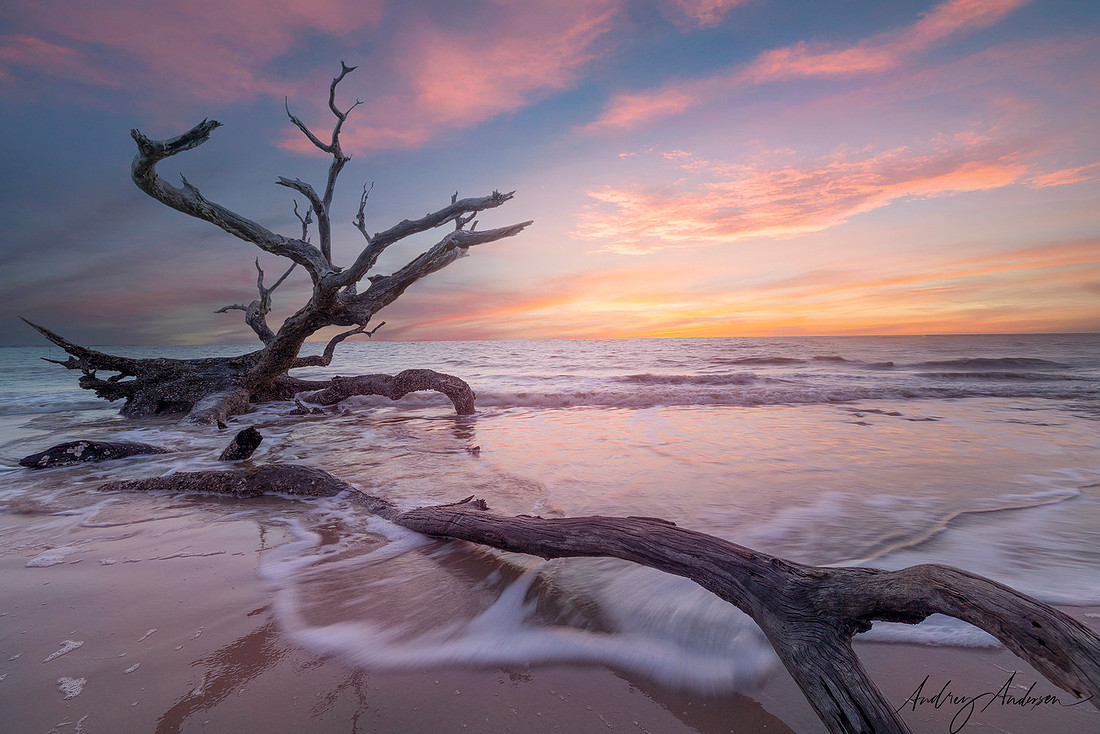
Easter Sunrise at Jekyll Island - My Favorite Photograph of 2025
Sunrise on Boneyard Beach
My favorite Photo of 2025
The sound of the waves and the scent of salt grew stronger as I walked along the sandy path to Jekyll Island’s Boneyard Beach. The night sky was lifting, revealing the first thin streaks of color on the horizon. All around me, the dawn began to illuminate the fallen trees, turning their jagged silhouettes into magnificent works of art.
It was Easter.
This is where my favorite photograph of 2025 was created.
What makes a photograph a favorite is not always technical perfection or even rarity. Sometimes it is the way an image holds a moment you didn’t expect or even know you needed.
Our journey to that Jekyll Island sunrise followed a long season of service that began years ago. Ever since my stepfather, Johnny, died, Bill and I have maintained a constant rhythm of helping my Mom with ongoing projects at her home and in her yard. This year, that commitment collided with a new challenge when Bill’s stepfather, Walter, suffered a major health crisis. Assisting with his care and rehabilitation required an intense, time-consuming effort from both Bill and me. While we consider it a privilege to support our families, early 2025 proved particularly taxing. Layered beneath those demands was the unaddressed loss of our dog, Doodle. He had passed away in February after seventeen years as a beloved member of our family. We hadn't yet stopped to fully process his absence. Life had been moving fast, and we had been meeting it head-on. But we were tired.
The week before Easter had been busy and hectic, just like the preceding weeks and months. We had managed to get Walter temporarily situated and had tackled a long list of repair and maintenance items at my Mom’s home. We even hosted a joyous double celebration for Easter and my niece’s baby shower on Saturday. But by the time the dishes were all put away and the last guest departed, we realized that we had an unexpected opening in our schedules. So without any planning at all, we hugged my Mom goodbye, jumped into VanGo, and headed south. We had no reservations and no clear destination, just a rare few days without any pressing obligations.
We drove until fatigue caught up with us somewhere near Brunswick, Georgia, and spent the night ‘boondocking’ in a Lowe’s parking lot. Early the next morning, we woke before sunrise and continued on toward Jekyll Island. When I realized we had just enough time to reach Boneyard Beach before the sun broke the horizon, that became our destination.
We arrived later than I would have preferred had this had been a planned destination. Ideally, I like to be in position thirty minutes before sunrise, when the pre-dawn colors first begin. That morning, I had no more than fifteen minutes to trudge through the soft sand and select a composition. I felt pressured to work quickly.
I spotted a composition I liked, but another photographer was already there. I hesitated. I didn’t want to crowd him or ‘borrow’ his vision. But as the sky deepened into brilliant pinks and oranges, I knew I couldn’t wait. I walked closer and apologized quietly. Then, I saw it.
A long, graceful branch extended from an overturned tree, curving gently away from the surf. With each wave, water washed softly over parts of the wood, then slipped back toward the ocean again. It was a striking composition that offered the possibility of a long exposure that could hold both stillness and motion. I worked quickly, testing settings and settling into a decision on how to best frame the tree against the coming light. I settled on a shutter speed of 1/6 sec; ISO 100 and f8. No filters; there was no time for that!
I captured a handful of frames. As the sky brightened and the colors faded, I stood up somewhat content with the results.
But Bill and I stayed on the beach.
Feeling no urgency at all, we stood propped up against the heavy branch of an overturned tree for almost thirty minutes. We listened to the waves and watched shorebirds wade through the sea foam in search of breakfast. It was a stillness we hadn’t allowed ourselves in a long time.
Easter is, at its heart, a story of darkness giving way to light, of life emerging where loss once stood. Standing on that beach, surrounded by fallen trees as the sun rose, I felt the truth of The Resurrection in a way that didn’t need explanation.
Nothing about that morning erased the weariness or loss of the months prior. Walter still faced challenges that would demand our attention. Doodle was still gone. The responsibilities waiting at home had not disappeared. But for those thirty minutes on the beach, something inside me settled.
When I look at “Easter Sunrise on Jekyll’s Boneyard Beach,” I do not see just driftwood and color in the sky. I remember standing beside Bill with no agenda and no urgency. I remember feeling tired but no longer heavy. The image is not my most technically perfect photograph of 2025, but it is the one that reminds me of restoration and renewal.
It is for me, the essence of Easter.
Encounter with a Costal Brown Bear
Whitehorse, Yukon to Haines, Alaska; five hours of ice-covered road through a lonely, vast stretch just below the Arctic Circle. Bill and I drove through it in awe, each bend in the highway coaxing out another surprised, “Wow… beautiful!” We saw fewer than ten cars the entire way. Snow swept sideways across the ice-glazed Alaska Highway while the dashboard optimistically insisted it was a warm 15°F. As we drove, we passed the time listening to Pastor Allen Nolan teach from the Book of Genesis, a book I’ve been studying for months now. The Bible’s account of creation tells us, among other things, that humans are to have of dominion (radah) over animals; however, as I listened to the lecture, I found myself wondering what that authority truly requires of us.
Our destination was Haines, Alaska, and the Chilkat Bald Eagle Preserve, but I had no idea that something other than eagles were waiting for us.
The Chilkat Bald Eagle Preserve hosts the world’s largest convocation of American Bald Eagles. They gather here in autumn because the Chilkat River remains unfrozen even when other nearby rivers freeze. The open waters allow the salmon to spawn and complete their lifecycle, guaranteeing an endless feast for the eagles. To see thousands of eagles along the river is common. Yet one morning, what I thought would be a day of eagle photography took a lucky turn.
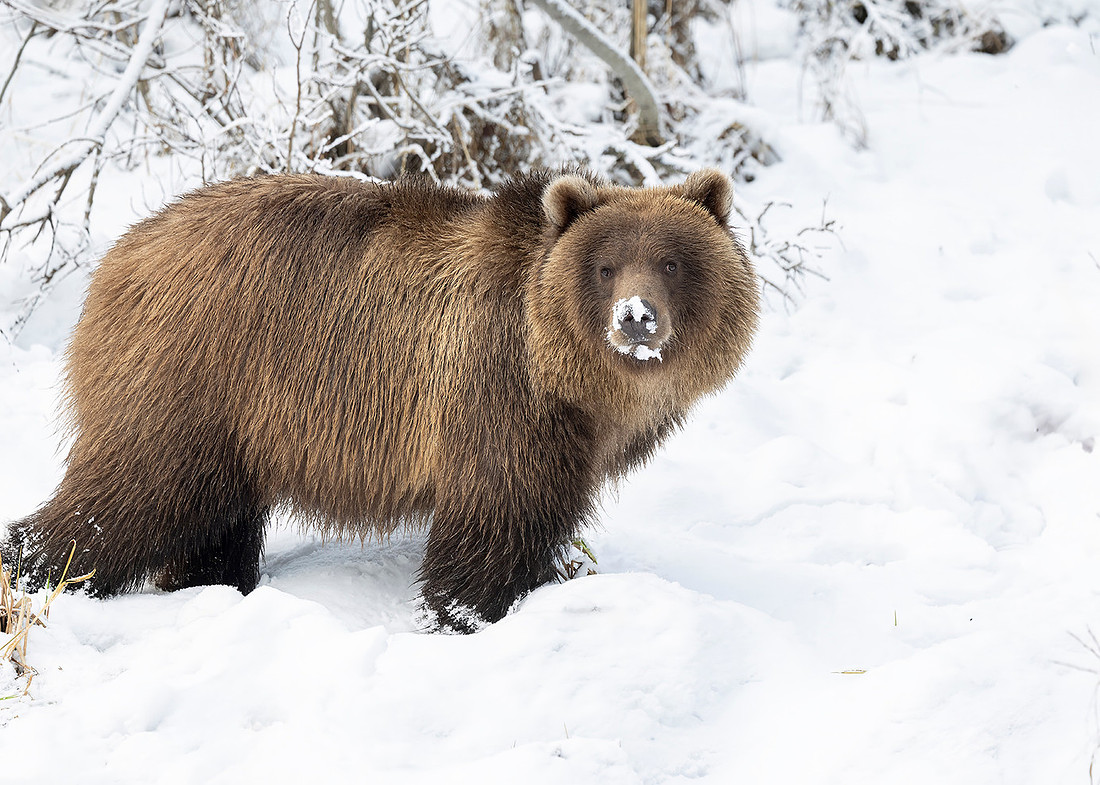
Walking along the riverbank Bill noticed a deep depression in the snow. It was the unmistakable, massive footprint of a Coastal Brown Bear. These bears, coastal cousins of the inland Grizzly, grow impressively large on a rich, fatty diet of salmon. We followed the tracks from the mountain, down across the road and north along the river’s edge until the prints finally vanished near the water.
We returned to the car and continued north. Then, in a clearing beside the river, we saw him: a large Coastal Brown Bear! Several onlookers had stopped, some standing far too close. The bear, preoccupied with the enormous salmon he had pulled from the river, seemed utterly uninterested in us.
I jumped from the car and stood about fifty feet away from the bear. He was in no hurry, giving me time to adjust camera settings, refine my composition, and even capture some video. I lifted my Canon R5M2 with RF100-500mm lens already in place, and looked through the viewfinder. I quickly settled on a shutter speed 1/320, ISO 800, and f6.3. Because I was shooting handheld, I was a little nervous about the relatively slow 1/320 shutter speed, but the bear was moving slow and needed as much light as possible because of the heavy cloud cover. I did not want to exceed an ISO of 800.
Golden-brown with dark legs and feet, he tore into the salmon with his teeth, using his massive right claw for leverage. Between bites, he glanced up at the river, then briefly at us. To my surprise, I felt no fear at all.
After finishing the salmon, he took a few steps, then plopped down to roll in the snow. It was a seemingly lighthearted and comedic end to his meal. When he rose and ambled north through heavy brush, the other onlookers moved up the road, hoping for another glimpse. I stayed behind, still savoring the moment.
Then, the bear turned, slipped into the river, and drifted back toward where I stood. I watched his massive head and two fuzzy ears sticking up above the water as he rode the current. Then, he paddled toward the far bank, climbed out, and shook off the water like a dog after a bath. I captured even more photographs of that wild, pure creature on the far riverbank, before he finally vanished.
I stood still, trying to commit the encounter to memory. I had tracked, found, and photographed a wild Coastal Brown Bear in his own domain. It was an exciting series of events! And this encounter had even given me the time to compose every frame with intention. I walked away with a photographer’s ultimate trophy.
But as I stood there elated, watching that magnificent creature trot away across snow and ice, the words of the Creation Account, words we had been studying on the drive to this very place, came into sharper focus. My encounter with this wild, untamed creature provided the true lens for interpreting the commandments in Genesis: Our dominion (radah) over the creatures of the earth is not a license for ownership, but rather a call to sacred, thoughtful stewardship (Shamar). It is a responsibility to guard and honor the wildness and perfection of creation. These animals are not merely subjects for art or sport; they are to be regarded with deep, quiet reverence, cherished and protected exactly as the Author of Life intended.
Appalachian Heartbeat - The Synchronous Fireflies of Elkmont
Appalachia is a place of mystery. It is a land steeped in ancient magic that feels whispered by the trees. In the shadowy folds of the Smoky Mountains, where mist clings to the ridges and moss blankets timeworn stones, a story flickers to life. Near the mossy arch locals call the Troll Bridge, a legend pulses to life each spring. It is a love story written in light, whispered through the forest, and never quite forgotten.
To witness and photograph the fleeting marvel of the synchronous fireflies demanded careful planning. My journey began in December of 2021, when I booked a campsite in Elkmont for early June of 2022. I knew the conditions needed for success: a moonless sky, clear weather, and access to the ruins of Daisy Town during the narrow window of June 1st to 14th. So on June 4th, 2022, I packed my Nikon D850 and a 17-35mm f/2.8 lens, choosing that wide-angle to gather maximum light. I arrived in Elkmont around 4 PM and spent an hour or so photographing Little River's rushing water and moss-covered rocks. Around 6 PM, I headed down Little River Trail, carrying my camera gear, a folding chair, my tripod, and two bottles of water. The crunch of dirt and gravel beneath my boots grounded me in reality, but something else stirred in the forest air - Something unseen, something mysterious.
The trail led me to the charming stone bridge that many call the Troll Bridge. With its graceful arch and moss-covered stones, it has always felt to me like more of a "Fairy Bridge," It’s an enchanted little place that seems borrowed from a fairy tale. To my left, Little River played a steady lullaby, its rhythm a constant thread among the sounds of the approaching night. Surrounded by this wild chorus, I set up my gear. That is when a story I heard long ago returned to me. A long forgotten campfire legend tells of two young lovers from feuding families who met in secret here, just outside Daisy Town, over a century ago. They found their way to this spot where the Fairy Bridge arched low over the stream and fireflies lit the night. It is said that the river’s edge still holds the shape of their footsteps, and the fireflies remember the rhythm of their hearts.
Darkness arrived.
Then, it began.
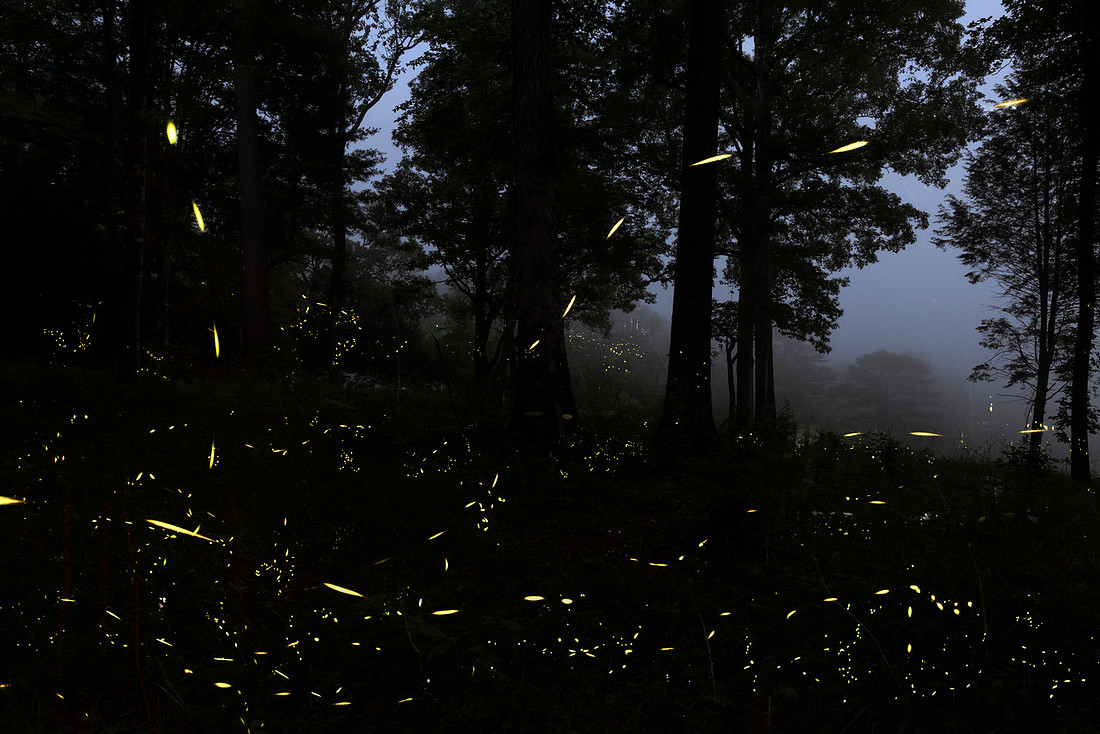
First, a few dim glimmers became faintly visible in the trees; tiny sparks blinking randomly in the dark. More joined, each flashing its own unpredictable rhythm. It was a beautiful visual chaos scattered throughout the forest. Over the next ten minutes, the scattered flickers grew steadily in number and intensity, like an unspoken conversation gaining volume and clarity. Then, impossibly, the flashes began to fall into step, pulsing together. On, On, On, before dissolving into a shared silence. A thousand lights blinked in unison. The forest flashed with golden light: five to eight bright pulses followed by eight to ten seconds of pure darkness. A living heartbeat. The synchronization is so precise it defies belief. Science explains it as something about mating rituals, bioluminescence, and evolutionary strategy. Yet, standing there, it felt like more. It felt like a heartbeat. Like a memory. Like the past tapping gently on the present.
As the forest pulsed with light and shadow, I fumbled with my camera. I adjusted my settings. I settled on the widest aperture of f/2.8, ISO 1600, and 30-second exposures to capture the ephemeral trails the fireflies carved through the air. Some moved in straight, glowing lines. Others danced in spirals or arabesques, as though choreographed by fairies. I took hundreds of shots, knowing the final image would be a composite (a stacking of frames to reveal the full spectacle.) This careful layering is necessary to show what the eye sees but a camera cannot fully capture in a single exposure.
But even as I worked, I couldn’t help but feel I was documenting more than biology. The old legend lingered in my mind. The story goes that when the secret lovers were torn apart by the bitter will of their feuding families, their hearts continued to reach for each other across the veil of time. When their footsteps vanished from these woods and they slipped into legend, the fireflies remembered. Now, every spring, for just a few nights, the forest pulses with light. Some say it's the spirits of a young couple, whose love defied their feuding families and found reunion here. Their timeless devotion manifests in the rhythmic pulse only the fireflies know how to create.
My final image captures the fireflies' dance in radiant detail. But the true ‘symphony behind the still’ is far richer. No image can do justice to this experience. It’s the hush of the river, the silent chimneys of Daisy Town watching from the woods, and the whispered legend of a love that could not be extinguished. That night, beneath a canopy of ancient trees and shimmering gold, I was more than a photographer. I was a witness to science, yes, but also to wonder. The forest then felt less like a place visited and more like a living memory, its ancient Appalachian heart beating in synchronized light, forever whispering of love that transcends time and sight.
Patagonia. Finding Light in the Darkness
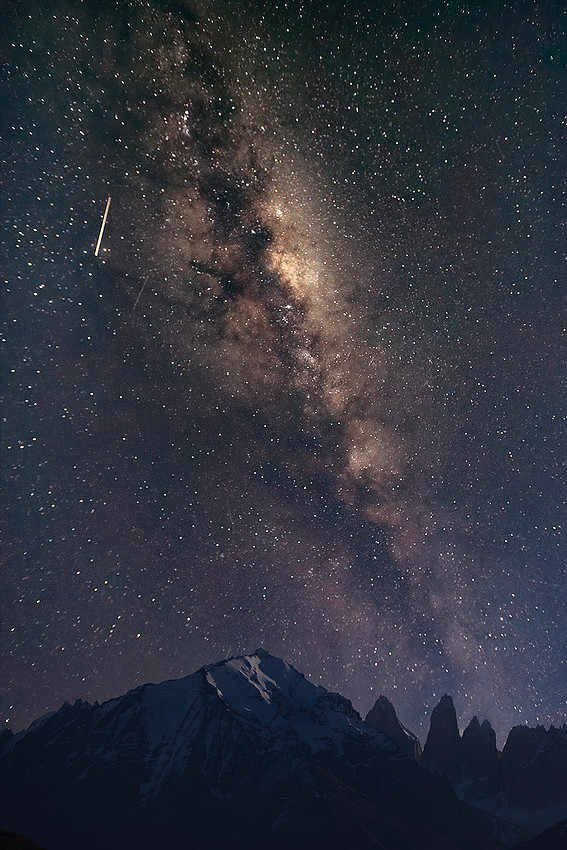
High on the mountain trail, the wind roared through the treetops of Patagonia, a soundscape of violent, rhythmic swirls that mirrored the brushstrokes of Van Gogh’s Starry Night. This relentless gale is the architect of the region, evidenced by the stunted, twisted trees that have spent centuries bowing toward the earth.
Days earlier, I had survived this same strenuous hike, convinced I would never make this nighttime ascent again. Yet, here I was, drawn back to these formidable slopes by the hope of capturing images of Patagonia in all its colorful autumn glory and by the unshakable determination of my friends Noel, Ana and Francis.
That earlier hike up had left me weary, my hip and knee still recovering from recent surgeries. I knew this second climb would again test my limits, but fortunately, Noel had arranged for a porter, Mattias, to help carry our gear. He met us in El Chalten, Argentina at the Pudu Lodge and immediately lightened my load by taking two of my lenses and a tripod. That may not sound like much, but it made my backpack significantly lighter as we set out on our rainy 3 AM ascent.
We were confident we knew the way and that is why we had hired Mattias, not a guide, but rather as a porter. But our confidence faded early into the hike when we reached a clearing with three diverging trails, and none of us could recall the correct path. Mattias, who climbed this mountain weekly, surely knew the way, yet he said nothing, firmly staying within the bounds of his role. Francis eventually made a semi-confident call: we’d take the rightmost trail even though we knew that was the direction that would take us closest to a steep drop off into the valley below. Mattias offered no reaction, no nod of approval, nor word of caution. Was his quiet meant to affirm our choice, or simply allow us the space to learn? I couldn’t tell. Yet as we proceeded up the path nearest the ledge, I felt sure he would have spoken if we were in danger. Our headlamps lit the way as we walked and chatted with him about life in Argentina. He was training for a marathon and these hikes kept him strong. His quiet presence and my lighter pack made this second ascent feel much less grueling.
Our goal was to be in place at Hidden Falls for a sunrise shot. The ephemeris showed sunrise at 8:15 AM so we estimated that we might see alpenglow on the peak of Fitz Roy as early as 7:45 AM. We arrived at the cliff above Hidden Falls around 6:30 AM, over an hour before first light. Mattias handed us our gear, offered each of us a sip of hot tea from his thermos, and then turned back down the mountain. The wind was violent and the cold was bitter. I shivered, wondering how I would endure until sunrise.
We stood on a narrow strip of land between two worlds. To one side lay a rocky expanse of boulders, moss, and wind-shaped trees; to the other, a jagged cliff fell away into a dangerous drop toward the river. Noel began scouting the area while Ana and I sought refuge behind a massive boulder, hoping simply to survive the next hour as the wind roared around us.
Moments later I heard Noel’s voice cut through the wind's roar. He knew my love for night sky photography and shouted, "Look up!" In my exhaustion and discomfort, I hadn’t even considered the sky. I had assumed the sky remained obscured by lingering rain clouds. But when I tilted my head back, I froze in awe. The sky had cleared completely and was so free of light pollution that the Milky Way stretched above me in stunning clarity. I could see not only the dense, glowing core of our galaxy but also the arching band of stars and dust that makes up the spiral arm on which we live. Back home in the Eastern United States, only a long-exposure photo reveals such detail. But here, from the far southern tip of Argentina, it was visible to the naked eye. A smile spread across my face. It wasn’t the sunrise I’d planned to capture, but it felt like a quiet nudge from something greater.
Suddenly, my extreme discomfort no longer mattered. I stood up and walked about fifty yards away from the boulder and the cliff. I quickly secured my Nikon D850 with a 17-35mm f 2.8 lens attached, onto the tripod. I took a test shot at an 8-second exposure. When the display lit up with the playback, I stared in disbelief. It was a perfectly exposed Milky Way in just 8 seconds! In the light polluted skies of the eastern United States, this was something that would have taken 15 - 25 seconds. I was giddy!
Noel and Francis were off scouting compositions, and Ana was still tucked behind the boulder. Though I wasn’t very far from them, I found myself briefly, quietly alone. Alone in Patagonia. Alone on a mountaintop in far southern Argentina. Alone beneath the stars. But I didn’t feel lonely, not even for a moment. What I felt was a beautiful solitude, a stillness that held no fear. I kept shooting, though compositions were scarce. Mostly, I just watched the sky, taking long exposures of our galactic home and letting the wonder settle over me. Eventually, a subtle light began to spread, and the Milky Way began to fade. My attention turned to photographing Fitz Roy and Hidden Falls.
I have often reflected on that night. As I stood there wrapped in wonder, it felt like the veil had been pulled back on something eternal. The Milky Way, expansive and clear, stretched overhead offering me a private encounter with the immensity of the cosmos. No voice spoke, no sign appeared, yet its beauty carried a quiet assurance: 'you are seen, you are protected, and though small, you are of grand and immeasurable value.'
I thought of Mattias, walking just behind us. He never told us where to go and never corrected our course. But I believe deeply that had we wandered toward danger, he would have stepped in. His silence wasn’t neglect: it was a belief that our own struggles would make us more capable navigators.
Looking back, I see his quiet presence as a reflection of a deeper truth. We are all allowed to wander for a reason. We must find our way through life’s demanding climbs and storms, knowing that even in solitude, we are never truly alone. And if we stumble, I know there is a presence, watchful and loving, that will not let us fall.