
Sweet Savannah


Sweet Savannah
Pink walls stood watch, a joyful space,
Where trumpet vines, their painted grace,
Climbed 'round the windows filled with light,
And butterflies and bees took flight.
A realm of wonder, joy, and play,
Where sweet Savannah spent her days.
With laughter’s sounds and golden light,
Savannah’s days were pure delight.
Dolls and puzzles, tales to read,
A dollhouse stood, so grand indeed.
And on a shelf, in twilight’s glow,
A rabbit high, a carrot low.
When nighttime’s quiet filled the air,
Playthings scattered everywhere,
Savannah sat on Mommy's knee,
As many books brought joy and glee,
Then Puffy hugged, and kissed goodnight,
The rabbit watched, in fading light.
Through starlit hours, Savannah slept,
While rabbit's secret vigil kept.
Then dawn's bright sunbeams filled the air,
Revealing changes, standing there.
The rabbit moved, the carrot near,
A curious sight, but day was here.
With bikes and playgrounds, and swings so high,
And watching clouds drift through the sky,
Cupcakes and bubbles, crayons bright,
Singing and dancing - pure delight.
Ice cream smiles, and flowers' dew,
Then rocking chair, as day withdrew.
And Savannah slept, with Puffy tight,
A peaceful sleep, throughout the night.
A day of joy, now peace and rest,
Night's calm descended, gently blessed.
High on the shelf, the carrot hung,
The rabbit watched, as night was spun.
Again Mom came, in morning's light,
To see the shelf, and what's not right.
Savannah woke, with sleepy grace,
A yawn, a kiss, on Puffy's face.
A question rose, in gentle way,
“Why dangling then, but not today?”
Savannah smiled, a knowing gleam,
“Perhaps it moved, within a dream?”
Then kites took flight, a blustery day,
Kickball games and youthful play.
Picnics and castles built by the lake
Long happy days with best friend Jake.
Again the day turned into night,
The rocking chair brought soft delight.
Savannah slept, with Puffy close,
As stillness grew, in soft repose.
Once more Mom saw, with gentle frown,
The carrot swayed, on rope hung down.
Once more the day began with light,
Again mom sees the curious sight.
"The shelf is high," she thought with dread,
"Savannah's small and still in her bed."
"How did the rabbit reach its prize,
While you were sleeping, 'neath closed eyes?”
With simple words, she softly told,
"The rabbit's wish, I could not hold.
I climbed the toy box with all my might,
And reached the rope, in fading light.
He looked so sad, upon his perch,
I helped him then, to end his search.”
A tender heart and gentle grace,
Savannah's love, fills every space.
She cares for rabbit, friend, and kin,
A sweet concern, from deep within.
Throughout her life, her heart so pure,
Leaves loving marks that will endure.
Doodle
Doodle
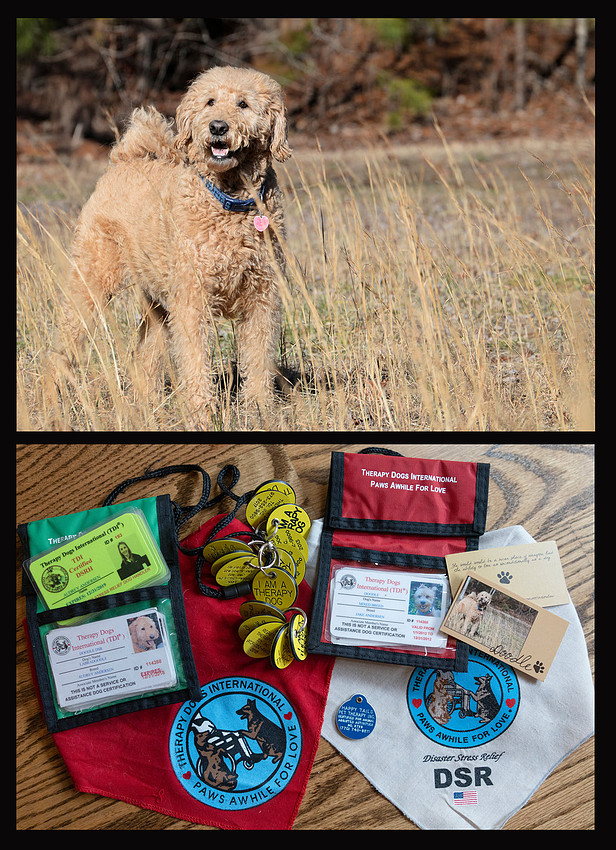
I pulled the red bandana from my top desk drawer and slipped it around Doodle’s neck. That magnificent curly tail wagged excitedly because he immediately understood that it was time to go to work. He hopped up into the back seat of my car, and we headed for Egleston Children's Hospital in Atlanta.
The red bandana was a badge of sorts, designating him as a certified therapy dog, but Doodle was born with a gift that went beyond his training and certification. Dog experts say that "Therapy dogs are born, not made,” and that was certainly true of Doodle. From the very beginning, he possessed a natural gift for compassion, as well as sensing when someone needed comfort and offering it without hesitation.
The process of becoming certified as a Therapy Dog/Handler team was not easy—a large percentage of dogs who take the certification test do not pass. Of course, all dogs are good dogs, but some are simply too enthusiastic to cooperate in the ways necessary to participate in these activities. Doodle, on the other hand, took to the training immediately. Though he was a rambunctious young pup, something shifted when that red bandana was placed around his neck. He instantly knew to calm down, to focus, and to obediently respond to both verbal and hand signal instructions. He was proud of himself. It was as if he understood from the beginning that he had a greater purpose.
So on that Sunday afternoon in April of 2012, Doodle, Jake, and I headed to Egleston Children’s Hospital in Atlanta, one of our regular visits. We met the other dog/handler teams outside of the hospital, a group of gentle souls ready to bring joy. Then, with a grand entrance, we paraded through the lobby to a waiting crowd of excited children. Doodle wore his red therapy dog bandana with a quiet dignity, understanding that when we tied it around his neck, it was time to serve. He was exceptional—not just well-trained, but deeply cooperative, almost as if he instinctively knew his purpose. He loved these visits! Small figures wearing hospital gowns, some in wheelchairs others in wagons, clapped with excitement, eager to meet the dogs. A shared sense of joy filled the atrium, a welcome distraction from the worries that weighed on their young hearts. They petted him, whispered secrets to him and told him about their pets at home.
On this particular visit, Doodle sat beside Jake and me, greeting children as he always did. But then something unusual happened. He lifted his head and looked away from the little girl who was petting him. I followed his gaze across the bustling hospital lobby. Something had drawn his attention - something I had not noticed. He didn't pull or tug but his attention shifted, and there was a subtle determination in his demeanor as he turned and walked purposefully toward the elevators. Without straining against the leash, without disobedience, he simply began to move.
Doodle had never done this before. Therapy dogs are trained to stay with their handlers, to wait for cues and to be led. But in this moment, he led me. I stood and allowed him to guide me across the lobby, weaving through the crowd with a purpose, until we reached a woman standing alone. She had just stepped off the elevator and leaned unsteadily against the wall for support. Her head was down, and I could not see her face. Doodle walked up to her, placed his body gently against her leg, and nudged her hand with his head.
The woman crumpled to her knees. Without hesitation, Doodle leaned in, pressing his face close to hers as silent sobs shook her body. She wrapped her arms around his neck and I saw tears fall from her cheeks and onto his golden curls. I stood there quietly, the leash slack in my hands, watching as my dog provided a comfort I didn’t yet understand.
After what felt like a long time, she whispered to Doodle, “Thank you.” She stayed there, kneeling, petting Doodle, her fingers tangled in his fur as she tried to calm herself. Finally, she stood up and spoke to me, her face racked with grief.
“My son is upstairs,” she said. “He won’t be going home.”
Her voice was heavy with the weight of her unimaginable grief. She told me that her son was six years old. He had been in and out of the hospital for chemotherapy treatments for months, but the doctors had just told her there was nothing more they could do. She had stepped off that elevator carrying the unbearable news that she would soon lose her child.
And somehow, in the middle of that crowded, noisy hospital lobby, Doodle had sensed her need and found her.
I didn’t know what to say. What words could possibly exist for a moment like this? So instead, I hugged her. She held onto me tightly before kneeling once more to embrace Doodle. Then, just as quietly as she had arrived, she walked away. I never saw her again.
I have remembered and contemplated that moment for 13 years.
Doodle had always been a flawless therapy dog—obedient, patient, gentle. But this was different. This was not training. This was something deeper, something intrinsic. No one else had noticed that woman standing there, alone in her sorrow. But Doodle had, and he sought her out when no one else did. He knew.
That day, I realized what made Doodle special. He was more than a well-trained therapy dog. He was born to comfort, born to serve, born to love — an angel among us with wings disguised by curly golden fur. And in that hospital lobby, when a grieving mother needed him most, he answered her pain with the quiet wisdom of a soul who understood.
Today, I opened my top desk drawer and saw the faded red bandana emblazoned with the logo of Therapy Dog International. Looped around the metal clip was an ID badge with Doodle’s Photo and eleven yellow disks, each a testament to another year of service. I stood there, heart breaking as I remembered all the times I lifted his credentials from the drawer, slipped the red bandana around the neck of my enthusiastic, proud Doodle Dog, and headed out for a visit. As I reached for the bandana today a tear escaped my eye—first one, then another, and another — a steady stream of grief.
Doodle, you see went to heaven last week at the grand old age of 17. He was the best "good boy" I've ever known. Though he's gone, his legacy remains—not just in my heart, but in the hearts of all the people whose lives he touched. In the quiet moments, I still feel his sweet presence and his knowing heart. And I know that somewhere, somehow, he is still finding those who need him most—offering them comfort, just as he always did. And I know that beyond the rainbow bridge, he still proudly wears his red bandana.
The Resplendent Quetzal
THE RESPLENDENT QUETZAL
Cold, misty rain stung my face as it swept across the hilltop, leaving every leaf and branch glazed in tiny droplets. Moisture coated my camera lens again. I wiped it with a microfiber cloth, again. My fingers, stiff from the chill, adjusted the tripod as I kept glancing toward the wild avocado tree. The branches draped toward the earth, heavy with rainwater and the weight of our expectations. All around me, the hushed voices of other photographers drifted in and out with the fog. We shifted between standing and sitting on small stools or overturned buckets, restless but unwilling to leave.
It was my ninth day in Costa Rica. The first eight had been spent beneath Arenal Volcano, along the humid Pacific coast, and deep inside dense jungle chasing glimpses of tropical birds. But this morning felt different. We had climbed high into Cerro de la Muerte, nearly 9,000 feet above sea level, for one reason: the Resplendent Quetzal.
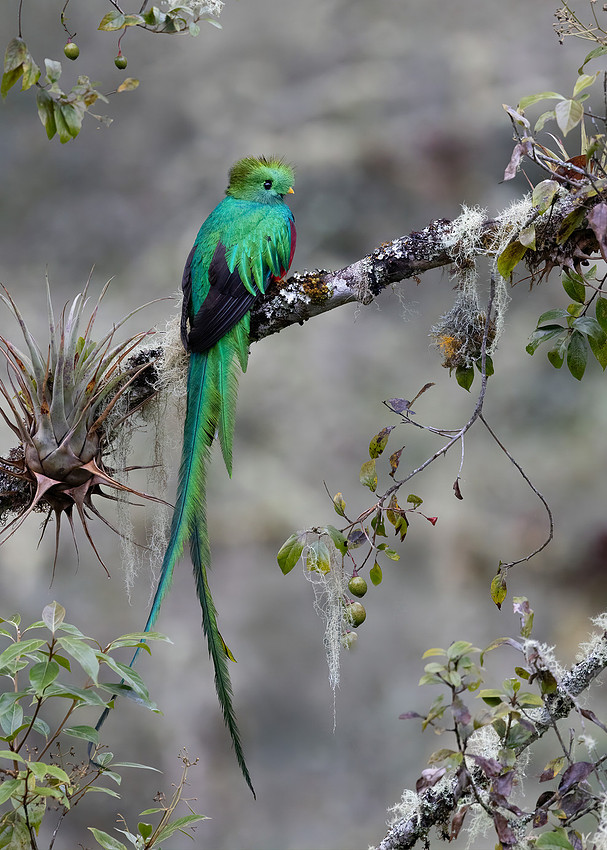
Quetzals are near-threatened and almost mythical in appearance, with emerald-green backs, crimson breasts, and impossibly long tail feathers that drift behind them like silk. The Aztecs once considered them sacred. Aztec rulers used the Quetzal’s vibrant tail feathers in their ceremonial headdresses to signal wealth and a connection to the divine. Now, they live quietly in the cloud forests of Central America, preferring mist and rain to sunlight. If the weather had been clear that day, we would have had no chance of seeing them at all.
As the afternoon faded, so did my hope. The cold in my hands made the rain feel more like an obstacle than an atmosphere. I started making peace with the disappointment.
Then a flash.
Emerald. Crimson.
A quetzal appeared as if conjured from the fog. It plucked an avocado and landed on a bare branch, the fruit clenched in its beak.
No one shouted. No one needed to. The air shifted. Shutters erupted in a soft, rapid chorus. Then another bird arrived. And another. What had felt hopeless just moments before became almost overwhelming. The tree came alive with green, red, and gold. Those long glorious tails, trailed through the branches like ribbons. I forgot the cold. I forgot the wait. The frustration evaporated and my camera went into overdrive, capturing stills and video. But even as I pressed the shutter, I knew the images would never fully illustrate what it felt like standing there.
And then, as quietly as they had arrived, they were gone. One by one, they vanished back into the mist, reversing the very magic that had brought them there.
We stood still for a long moment after the last one disappeared. No one wanted to be the first to speak, as if talking might undo what we had just witnessed.
Walking back down that rain-soaked hillside, I realized the wait had been part of it. The cold. The doubt. The quiet calculation of whether it had been worth it. If they had appeared within the first hour, I would have been thrilled. But I would not have felt the same depth of excitement.
The quetzals did not owe us a performance. They simply appeared when they did.
And somehow, standing in the mist that day, that felt like enough.
Under The Smoky Mountain Stars: A Cades Cove Mystery
The Smokies are full of stories—tales of mountain spirits and shadows that move when no one’s looking. But those are just old campfire stories, right?
Cades Cove, a serene valley nestled deep in the Smokies, feels like a place where time stands still. Weathered homesteads, one-room churches, and abandoned family cemeteries lie scattered across the valley, serving as silent reminders of the resilient Appalachian settlers who once called this place home. Their lives were marked by self-reliance and a deep-rooted connection to the land, and though they are long gone, their presence lingers in the misty fields and dense woodlands.
I spent the afternoon of October 6 in Cades Cove, hiking along the Rich Mountain Loop Trail in search of black bears while admiring the beauty of autumn in Southern Appalachia. As the day wore on, the fading light signaled that evening was approaching, and with it, an opportunity I had long awaited—a perfectly dark night to capture the Milky Way from Cades Cove.
The sun set at 7:13 p.m. just as I passed the visitor center and headed down Parson’s Branch Road, hoping to catch a glimpse of “Hollywood,” a coyote I often encounter in that area. By the time I reached Hyatt Lane, darkness had enveloped the landscape, and the usual bustle had faded into the tranquil sounds of nature. The last visitors had trickled out, leaving behind an eerie yet peaceful solitude—a rare moment in this ordinarily crowded place.
I put my car in park and rolled down the windows. Twilight faded into the deep blues of night. I knew that in about 10 minutes, the Milky Way would become visible in the southern sky. There was so little light I could not even see the fields of tall grass that line both sides of Hyatt Lane. I knew the crescent moon would soon fall below the horizon, leaving the sky perfectly dark for the shot I’d been dreaming of.
I stepped out onto the dirt road, camera in hand, to prepare for the shot. I took a few 12-second exposures just to frame the shot and confirm my settings, then I turned off my camera and stood silently to wait on the moon to set. A cool breeze whispered through the valley, and the deepening night wrapped around me like a soft, dark blanket. I welcomed the quiet and solitude, at peace beneath the vast sky. But as the moon faded and darkness deepened, the air subtly shifted. The silence grew heavier, as if the night itself was holding its breath, watching.
Then something caught my ear—a sound, faint but distinct, coming from nearby.
I froze; ears straining to identify the noise. It was close—too close—and not small. My mind raced. “Do bears move at night?” I wondered, suddenly aware of the vast black wilderness that surrounded me. A pack of coyotes howled in the distance, their mournful calls echoing off the mountains lining the valley. Normally, I would have reveled in such a wild, untamed sound, but tonight it seemed to carry a sense of foreboding.
The once-familiar landscape now felt foreign, almost otherworldly. I became acutely aware that I was alone in the darkness. The campground was approximately 5 miles away from where I stood, and there was zero cell phone signal. A part of me wanted to stay, to absorb the beauty of the Milky Way as it slowly revealed itself against the deepening night sky. But another part of me urged caution, warning of the things that move in the darkness unseen.
Playing it safe, I climbed back into my Bronco, leaving my camera outside atop the tripod. I rolled the windows down to better listen for any further sounds. Again, the noise broke the silence, closer this time- something moving through the thick grass to my left. My pulse quickened, and instinctively, I reached for the ignition.
The Bronco roared to life, casting bright beams of light onto the dirt road ahead. I promptly engaged the 360-degree cameras, hoping they’d offer a better view of whatever was out there. As I glanced at the screen - a jolt of fear shot through me.
Something dashed across Hyatt Lane, right in front of the car—mere feet beyond the headlights. It moved so fast that I barely registered it, but what I did see sent a shiver down my spine. It wasn’t an animal—at least, not one I recognized. It was large, about the size of a bear or a wild boar, but there was something off.
It didn’t run, not exactly. It floated—low to the ground, moving with an unnatural grace, as if it wasn’t tethered to the earth. The figure was white, but not solid—almost translucent, like a wisp of fog or a shadow of light. It was there, and yet, it wasn’t. I blinked, straining to make sense of what I had just seen, but it was already gone, swallowed by the darkness.
I sat there, frozen, heart pounding. Part of me wanted to drive away immediately, but my tripod and camera were still out there, standing in the middle of Hyatt Lane. After a long, shaky breath, I leaned out the window, trying to grab them without getting out of the Bronco. No such luck—they were too far away
There was no avoiding it—I had to step back out into the night. As I stepped out of the safety of my vehicle, the coyotes howled again, closer this time, as if reminding me of my isolation. I moved quickly, heart racing as I disconnected the camera from the ball head and collapsed the tripod. My hands shook as I fumbled with each of the tripod’s nine joints, all the while feeling as though unseen eyes watched me from the shadows.
Once I had my equipment, I bolted back into the Bronco, slammed the door, immediately locked the doors and hit the gas. The tires kicked up gravel on the narrow dirt road, but I didn’t care—I just wanted to get out of there! I barely slowed down as I made the left turn from Hyatt Lane onto the paved Loop Road. Four miles stretched between me and the exit, and with every turn, I glanced nervously in the rearview mirror, half-expecting to see something strange chasing me.
Finally I reached the “Support the Bears” collection box, a sign I knew meant I was nearing the exit. Relief washed over me as the familiar sight of the stop sign across from the Cades Cove Campground Store came into view. The moment I reached it, I finally exhaled. I was no longer alone in the depths of the dark cove.
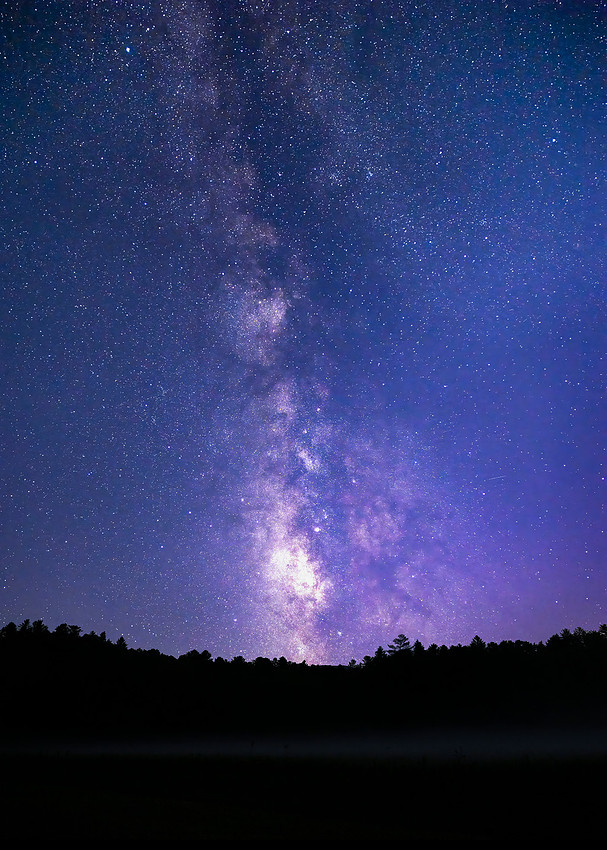
As I drove out of Cades Cove and on toward Townsend, Tennessee that night, heart still racing from the frightening encounter, I couldn’t help but reflect on the strangeness of it all. I had come to capture the Milky Way, only to find myself fleeing from a “ghost” like some character in an old Scooby-Doo cartoon. My Milky Way shot was nice, but not quite what I had envisioned—the faint glow of the crescent moon lingered in the frame, softening the darkness I had hoped for. Yet, as I reviewed the image, I understood it was now a testament to the night’s unexpected encounter, a reflection of the mysteries waiting to be uncovered in the Smoky Mountains.
What had I seen out there? Perhaps it was just the wind teasing the tall grass, or maybe my mind played tricks on me under the weight of the night’s stillness. But part of me wonders if I had brushed against something ancient, as if a hidden story of this place surfaced for just a moment, only to dissolve back into the shadows. Perhaps the spirits of those who once walked the hills and worked the land were there with me that evening and they accidentally passed close enough for me to catch a brief glimpse.
In the end, whether it was a fleeting brush with the past or simply the magic of the mountains, I left feeling that some questions are not meant to be answered, but rather felt, lingering in the Smoky Mountain night. Cades Cove may be serene by day, but as night falls, it whispers of things long forgotten—its people, its stories, and the boundary between this world and one unseen.
The Old Lanier Farm - Post Hurricane Helene Revision
My mind often drifts back in time to the shady sanctuary of my Grandmother Lanier's front porch. It was a welcome refuge for me during the late Sixties and Seventies when I was a freckled-faced, halter-top-wearing little girl.
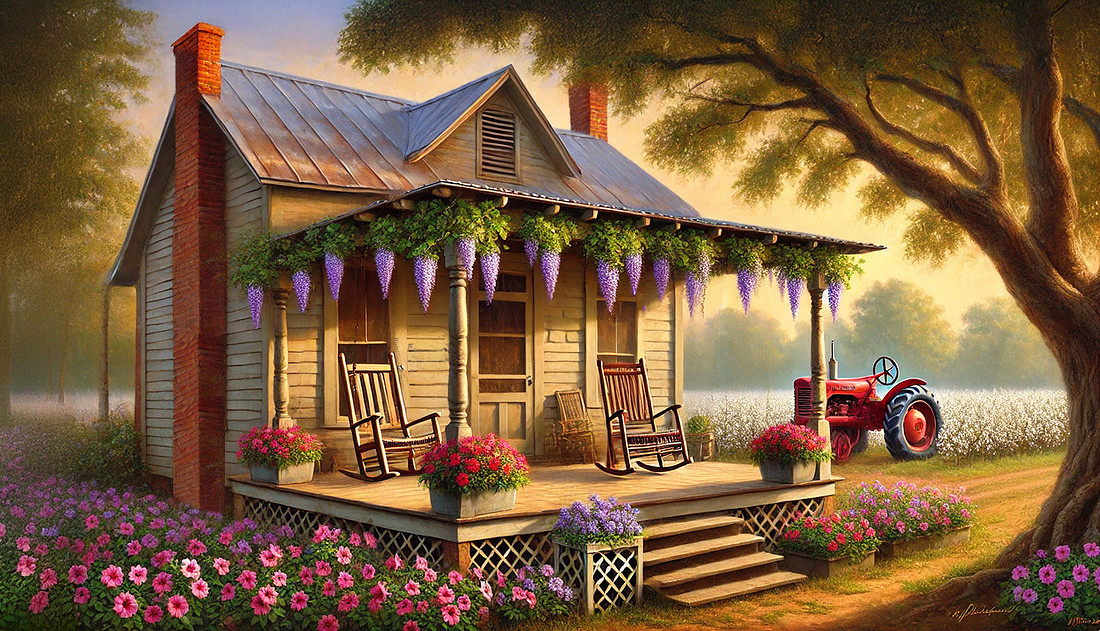
As children my brother Andy, sister Amber, cousin Stuart and I roamed my Grandparents’ farm on countless hot summer mornings and although we did not have cell phones, iPads, computers or video games, there was always an unlimited supply of interesting things to do and see. Using cane poles and earthworms dug from the moist soil beneath bricks and stones, we plucked hungry bream from the small farm pond that sat quietly beyond my Grandmother’s bell pepper garden. We splashed in a small branch that flowed near the entrance to the farm and we devoured plump blackberries that grew wild along the fence lines. We routinely checked the nests inside the chicken coop for fresh eggs and using our bare feet as “forms” we built “frog houses” in the sandy soil near the mailbox. We took turns climbing into the seat of my Papa Lanier’s 1949 rusty red Farmall tractor and pretended to drive it up and down along rows of cotton. The four of us played largely unsupervised for many long happy hours, but by midday, exhausted and hungry, we retreated to the inviting shade of my Grandparents’ front porch.
The porch adorned the front of a simple yet gracious two bedroom wood frame farmhouse which was built in 1909 by my Great Grandfather Thomas Lincoln Lanier and his wife Deborah Daughtry Lanier before being passed along to my Grandmother and Papa shortly after they married in 1922. The porch stood watch over the 73 acre farm which is located 15 miles north of Metter, Georgia on a red dirt road near the intersection of Georgia Highway 121 and Rosemary Church Road.
The porch was, roughly 35 feet long, 10 feet wide and a mere 3 feet off the ground. There were no rails along the sides of the porch, but long, rectangular flower pots spilling with fragrant and colorful petunias lined the edges. Thick woody wisteria vines, dripping with pale purple blossoms and alive with humming birds and bees, wound their way up the four lattice pillars that supported the shiny tin roof. Two weathered wooden rocking chairs filled one end of the porch while a wooden swing supported by rusty chains occupied the opposite end.
After our morning adventures on the farm the four of us would ascend the three concrete steps that lead from the patch of thick St. Augustine grass and onto the green painted wooden deck of the front porch. As if by clockwork my Grandmother Maggie and Aunt Colleen would emerge from the screen door – the door snapping back with a resounding ‘thwack” to keep the flies out of the house. Adorned in simple cotton house dresses and lace trimmed aprons, Grandmother and Colleen served us “dinner,” as the midday meal was called, usually consisting of cold biscuits and thick cut bacon left over from breakfast, okra, peas, corn and tomatoes all fresh from the garden, fried chicken and of course plenty of sweet iced tea. Seated along the sides of the porch with our dirty bare feet dangling over the edge, we devoured our lunch without regard for the calorie count of the sweet tea, the fat content of the bacon or the number of carbs contained in the biscuits. Yes these were carefree times.
Lethargic from eating second and even third helpings of delicious southern fare we remained on the porch until we could regain enough energy to continue the important daily tasks that remained. Andy and Stewart would lay back with their feet up on the rockers and discuss issues of vital importance such as how to build a more effective rabbit trap or speculate on the size of “Old’ Moe”, the legendary monster sized bass that lived in the farm pond and shrewdly evaded capture year after year. My sister and I sat on the swing as it gently swayed back and forth in the negligible afternoon breeze. It was not uncommon for my grandparents’ old dog Whitey to timidly approach us as we lounged lazily in the afternoon warmth. Whitey was a “mut” no heavier than 35 pounds. As his name suggested he was predominately white with one tan spot about the size of a dinner plate on his right side. Whitey was bashful most likely because my Grandmother Lanier chased him off her porch daily with a straw broom. But with Grandmother safely out of sight in the kitchen on the back of the house, we would quietly encourage Whitey to venture onto the porch. He was scared and although he was reluctant to get close to us we could tell that he wanted us to pet him. My sister Amber would say to me, “he likes to be petted on his spot.” Never questioning the authenticity of the apparent mental telepathy she shared with Whitey, I dutifully obliged and stuck out my foot as far as it could reach in the direction of the reticent pup. To our delight, Whitey would cautiously sidle up even closer to us and allowing our outstretched toes to rub his spot.
Mealtime in the comfort of the shady porch was a nice break but we didn’t dwell there very long. The afternoons gave us plenty of daylight to explore the inside of the barn, climb the huge crepe myrtle trees in the front yard, sneak a peek down into the dark scary depths of the well and pick bouquets of colorful Old Maids from beside the corn crib. So, like paratroopers exiting a C-130, we would leap from the end of the porch, one by one, each landing in the pile of soft, powdery soil that was just below an ancient pecan tree.
I don’t know why, but the days lingered longer and time seemed to move more slowly perched on a swing or a rocker on that old front porch. Today, as I spend time on my own porch overlooking the woods behind my house, I often think about the old Lanier farmhouse. If I close my eyes, I can see the mighty pecan trees that surrounded the structure, I can smell the honeysuckle blossoms blooming nearby, I can hear the lonely cry of a whippoorwill at dusk, and wonder – where has all the time gone.
My Grandmother Lanier died in 1990, and my Aunt Colleen left us almost seven years ago. I miss them both dearly. Yet, even after the loss of family members and the damage caused by Hurricane Helene, that porch still stands, waiting for me to rest in its shade and remember. The storm swept through the Lanier Farm, felling trees and reducing the tobacco barn to rubble, but the old farmhouse remained miraculously untouched—a quiet testament to the generations of strength and love woven into its walls. Though the landscape has now been changed forever, the spirit of the farm endures, echoing of those cherished summer days and carrying forward the hope of new seasons yet to come.