
Cahaba Lilies
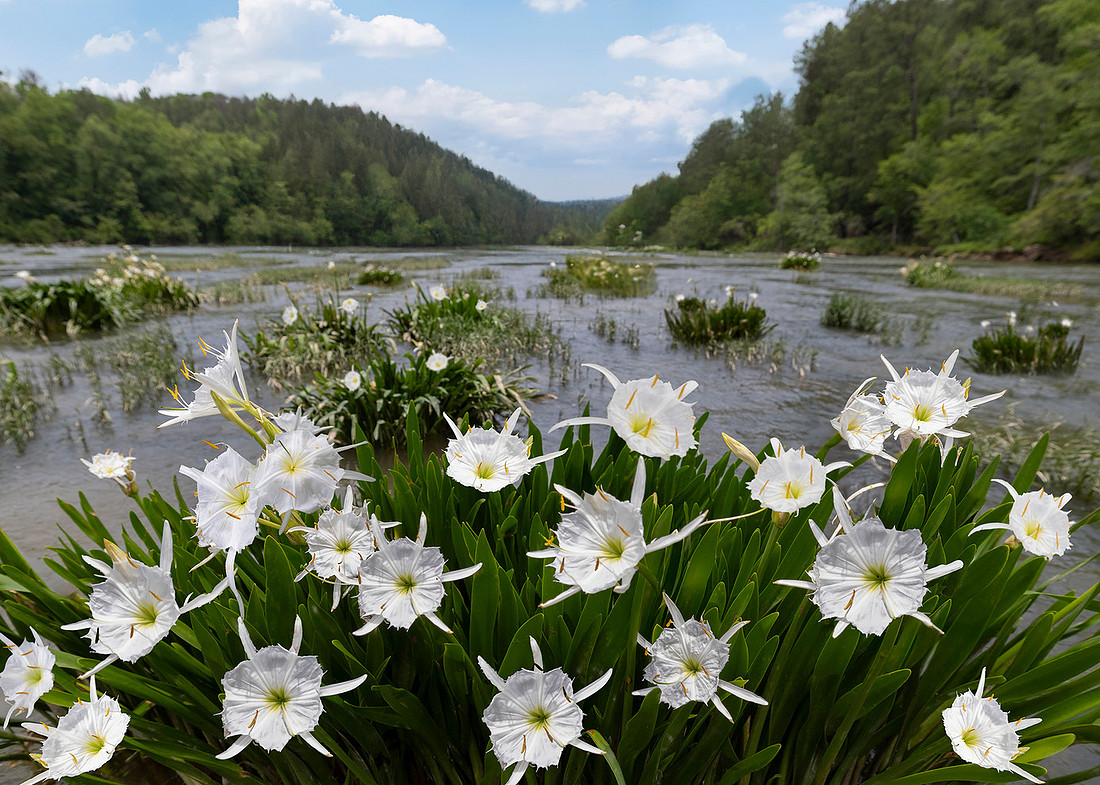

Cahaba Lilies
My fascination with flowers, a passion inherited from my mother, led me on an unforgettable quest in May of 2025. My goal: to find and photograph the elusive Hymenocallis coronaria, a rare aquatic flower that thrives in the swift, shallow rivers of the Southeastern United States. This striking perennial, endemic to Alabama, Georgia and South Carolina, is often called the Shoal Lily, however in Alabama it is widely known as the Cahaba Lily. It requires fast-moving water, rocky shoals, and abundant sunlight to survive. Each fragrant blossom lasts for just one day. Tragically, dam construction has decimated its habitat, and today, only around 50 viable populations remain. One of the largest is nestled within Alabama’s Cahaba River National Wildlife Refuge.
Armed with this knowledge and a spirit for adventure, Bill and I packed up our camper van, affectionately dubbed Van Go, and set out for West Blocton, Alabama. Our mission: to find and photograph the Cahaba Lilies blooming at Hargrove Shoals, a section of the Cahaba River located within the refuge. Directions were vague: a dirt road that dead-ended at a blue gate, followed by a crossing of Caffee Creek, and then a mile hike along an unmarked trail.
Caffee Creek presented the first challenge. Its surprising depth, three to four feet, forced me to remove my backpack and wade through the current holding my camera gear above my head.
At the end of the mile long hike, we arrived at Hargrove Shoals and were captivated: thousands of radiant lilies blanketed the river like scattered stars. But between us and the flowers stretched a 40-foot span of water, deceptively still and surprisingly deep. Bill, at 6’2”, waded in and quickly confirmed it was well over his head. Swimming across with camera gear wasn’t an option. So, back we went; through the woods, across the creek, and out of the refuge.
As dusk settled, we found a solution in the most unlikely place: Walmart. For $35, we bought a rubber boat.
We returned to the refuge at dawn. We inflated the boat and hiked back through the forest with Bill carrying the boat and me carrying the camera gear. Once more, we reached Hargrove Shoals. I loaded the gear into the boat, and at Bill’s suggestion, climbed in as well. With quiet resolve, he slipped into the water and began swimming across, pulling me and the boat behind.
We finally reached the lilies and it was magical; thousands of white blossoms danced in the rushing current, their sunlit, white petals glowing against the dark rocks beneath. But the shoals were perilous. Slippery stones and unexpected holes made every step treacherous. We quickly learned to use the boat as a floating workstation, keeping the camera securely stowed until needed for a shot. Bill and I walked or swam alongside the boat, carefully guiding it through deeper, swifter channels. Upon reaching a rocky shoal, I would climb up, tripod in hand, soaked yet resolute.
Once among the lilies, the real work began. I moved cautiously, scanning for the perfect composition. I photographed upstream, where the river surged toward me, and downstream, where the lilies receded into the distance. Every frame deepened my joy. Though breathtaking, I sensed I had missed peak bloom by about a week; some green leaves showed signs of fading, and many blooms had already fallen. This only fueled my resolve, and I knew I would return again next year, closer to the height of their glory.
Then came the low rumble of thunder.
Knowing that our return across the shoals, the deep river channel, the forest trail, and Caffee Creek would take time, we packed up quickly. As we reached Van Go, the storm broke, rain cascading over the windshield as we drove out of the refuge.
Every detail - the research, the early morning chill, the physical obstacles, the improvisation, Bill’s unwavering support, and the drama of the weather all worked together to form the narrative behind the final image. The final product is more than a photograph. It is a symphony of circumstance, effort, and determination.
But this journey offered more than beauty and adventure. It offered a lesson.
The Cahaba Lily blooms in wild, rushing water; its delicate elegance forged in the very turbulence that threatens its survival. Its beauty is not in spite of the current, but because of it. That paradox struck me. How often is this true for people as well?
True beauty and resilience often flowers in life’s swiftest currents, amid adversity, uncertainty, and challenge. Like the lily rooted in slippery shoals, people who endure life’s trials often emerge with strength, wisdom, and beauty shaped by their struggles. Their hardships don’t obscure their brilliance—they reveal it.
In the end, the Cahaba Lily is more than a rare flower; it’s a metaphor. A symbol of the fragile, fierce beauty that blooms not where the water is calm, but where it races over jagged rocks, in the shallow, churning turbulence of life’s shoals.
The Dot Bird
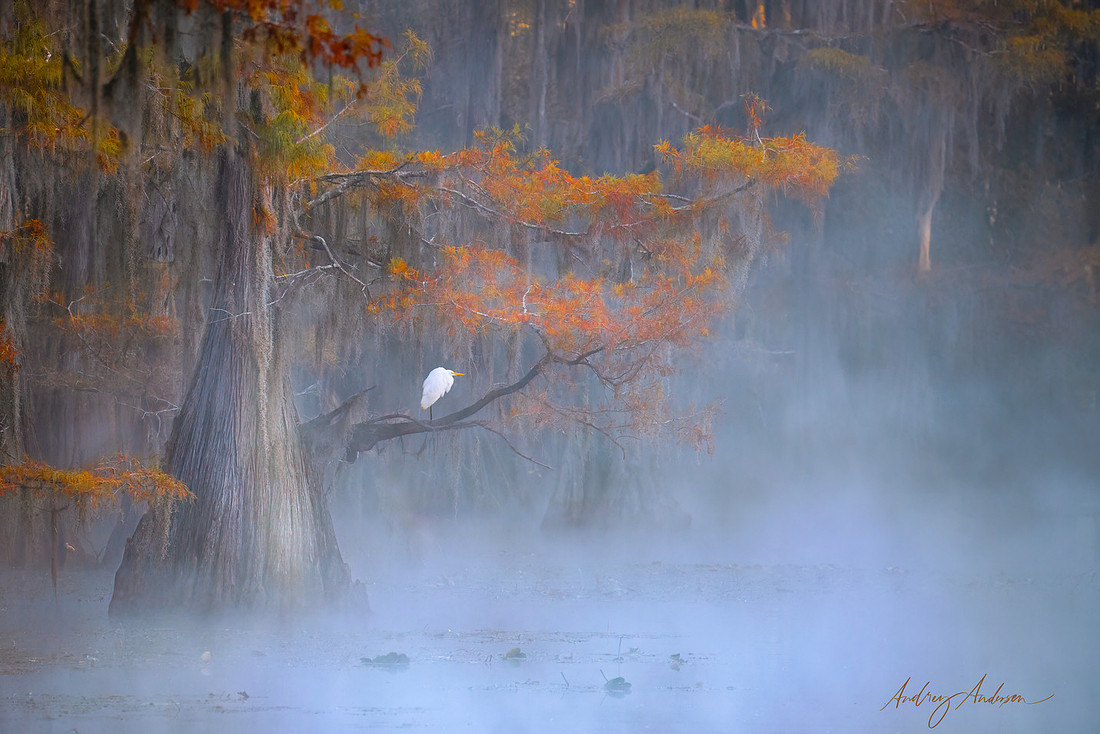
The Dot Bird
My favorite photographs often capture more than just a scene; they tell a story or teach a little lesson. One such image, "The Dot Bird," taken in early November 2023, transports me back to a very foggy morning at Caddo Lake State Park in Uncertain, Texas. My husband and I were there for a four-day trip; he for fishing in the bayou, and me for photographing the anticipated fall colors.
I awoke on our first morning to realize that luck was on my side. A sudden overnight temperature drop ushered in a dense, mystical fog that would surely create dramatic visual conditions. We drove to the state park, where I joined fellow photographers around 7 AM. Despite the cold and a treacherous, thin layer of micro-ice on the dock’s wooden planks, I was ready. To my delight I could see that the fog greatly enhanced the scene's moodiness.
Through my Nikon Z8 with attached 600mm lens I spotted a white egret about 75 yards away on a cypress branch. The distance from the dock to the bird made it appear very small. A man standing nearby loudly dismissed it: "That's what I call a 'dot bird’; it’s not worth trying to photograph that thing!” Yet, as I gazed through my lens, a realization dawned. This wasn't a bird shot; it was a moody, foggy landscape shot, and the egret, despite its small size within the frame, became a powerful anchor.
The egret provided scale, making the vastness of the cypress swamp evident. More importantly, this lone living element animated the entire scene, breathing a subtle but powerful vitality into the misty landscape. It transformed a beautiful vista into a compelling narrative.
I snapped several frames. Moments later, my friend Edwin whispered, "Get ready! They fly right after they poop!" And that is exactly what happened; the egret pooped and then vanished into the mist. I moved on to photograph a foggy scene of a heron fishing along the shore. It was only during post-processing that the quiet power of that "dot bird," initially dismissed by others, truly struck me, revealing how even the most overlooked or small details can become the heart of an image.
Monument Valley Rainbow
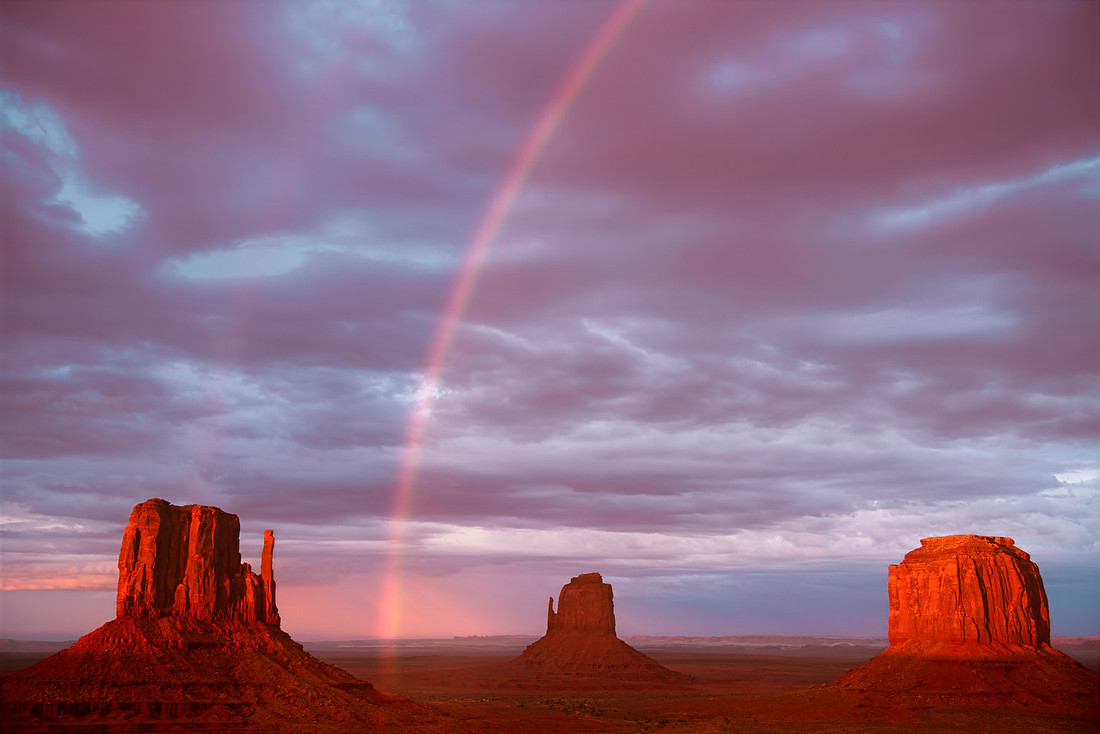
Rainbow over Monument Valley
The air in Monument Valley tasted of dust and relentless heat on July 28, 2017. The towering sandstone monoliths, affectionately known as 'elephants,' loomed under an unforgiving, hazy sky, devoid of the vibrant light photographers crave. The dried up tumbleweeds offered little inspiration as foreground elements. As a photographer constantly chasing that ethereal glow, I found myself in a familiar bind: great subject, terrible conditions.
My travel companion and photographic mentor, Edwin Martinez, seemed unfazed. Edwin, a Canon "Crusader of Light," is a master of all things photography, from the intricate technical aspects of gear, to the artistry of composition, and the magic of post-processing. Over the past 10 years, Edwin has been my teacher on photography workshops and tours and has been instrumental in my growth as a photographer. But our connection runs deeper — we just get each other and always seem to find humor in the subtle absurdities that others miss.
And, we’ve certainly had our share of memorable, often hilarious, moments across continents. Edwin, as a co-owner of Wide Horizon Photo Tours, is almost always the embodiment of professionalism, but there are times when that professional facade takes a brief, humorous break. Take the time we were photographing lightning-fast bats in Costa Rica at night. We were all instructed to switch our cameras to single-shot mode to protect the flash units. But with only minutes left, and wanting to ensure an additional capture, Edwin mischievously grabbed my camera and, knowing full well the single-shot rule, switched it to burst mode. Then, a bat swooped in from the darkness and my camera triggered the flash. Multiple flashes fired so fast that it was virtually imperceptible to anyone. Incredibly, Alvaro, another sharp-eyed tour leader, instantly noticed the tell-tale burst and called us out, leading to a good-natured but deserved reprimand for me! Over the years, Edwin and I have encountered so many funny circumstances that some moments are now just shorthand between us, like the "change the frog" incident in Costa Rica or the "dot bird" saga from Caddo Lake, Texas. These little inside jokes are a testament to a friendship that transcends the lens.
Our journey through the magnificent desert landscapes of the southwestern United States had brought us to this moment in July of 2017. As we pulled into Monument Valley that afternoon, around three or four o'clock, the conversation had oddly turned to snakes. Living in Georgia, I'm accustomed to being aware of them and I always wear long pants and sturdy hiking boots when venturing off-trail. The deserts of Utah, I knew, were prime rattlesnake country, and I'd dressed accordingly, despite the oppressive heat. I began rattling off my precautions to Edwin – "Rattlesnakes are masters of camouflage, so watch where you step,” “don’t reach under any rocks or sticks,” and of course, “wear closed toed shoes." He seemed to take my precautions seriously, but I wasn't sure if he was genuinely concerned or just playing along.
The SUVs rolled to a dusty stop, and the tour participants stepped out. Everyone scattered across the parched landscape, searching in vain for foreground elements or leading lines that might help to showcase the giant "elephants" in the background. In the ensuing search for a compelling shot, I'd completely forgotten about the earlier snake discussion.
Then, I heard movement behind me, followed by a peculiar sound: a constant, repetitive hissing, whistling, sssssssssswishy sort of noise. I turned, confused, to see Edwin, camera in hand, creating these strange sounds as he wandered cautiously among the nearby tumbleweeds. "What are you doing?" I asked, utterly baffled. His reply, delivered with a perfectly straight face, was, “trying to scare off any rattlesnakes that may be lurking!” I couldn't help but laugh; it was pure, classic Edwin.
We stayed on the desert floor for about an hour. I captured some photos that were marginally satisfactory as documentary evidence of this place, but none held the artistic appeal I sought. Disappointed, we all piled back into our assigned vehicles.
After a quick pit stop at the Navajo Tribal Park Visitor Center, we were all set to drive to our next destination. As I reached for the vehicle door, I caught a glimpse of Edwin in my peripheral vision. He was running toward the edge of the parking area, camera in hand — a dead sprint towards the overlook.
I was momentarily confused, but I quickly understood. This was a critical lesson I now always remember: when Edwin runs with his camera, I should grab mine and run too. So I did — we all did.
As I neared the overlook, the reason for his haste became breathtakingly clear: a storm was rolling into Monument Valley, and a magnificent rainbow had arched above the "elephants." I lifted my Nikon D850 with attached 27-70 lens up to my eye. I immediately realized that a wider lens would have been better for this expansive scene, but time was of the essence—rainbows, I knew, could be fleeting. So I fired off about five clicks with the lens I had before the rainbow vanished and the thunderstorm enveloped the valley.
We scrambled back into the SUVs and drove out of the valley, exhilarated by the magnificent rainbow. Over dinner at The Swinging Steak—an outdoor restaurant where steaks cooked on a screen that swung back and forth over an open fire—our group remained buoyant, reliving that amazing, unexpected shot.
My photograph of the rainbow above Monument Valley captures a beautiful moment in time. But the 'symphony behind the still' plays out in the frustration of the imperfect conditions for photography that existed that day, the hilarity of Edwin's rattlesnake deterrent behaviors, and the mad, exhilarating rush towards a vanishing opportunity. Yet the greatest realization lies in the dual rarity it reveals: the stunning good fortune of witnessing such a perfect natural spectacle, and the even more remarkable good fortune of finding a friend like Edwin — someone whose shared love for photography, generous spirit in teaching the craft, and similar sense of humor truly elevates me and everyone around him.
Blueprint for Flight
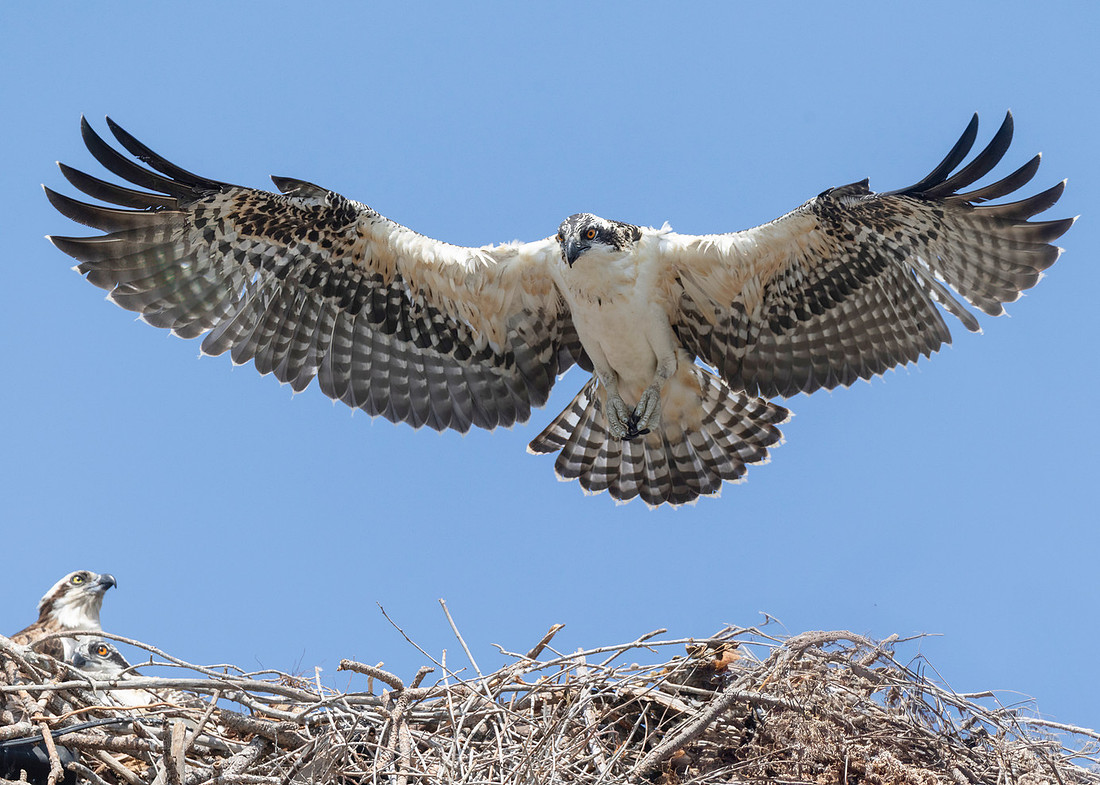
Blueprint for Flight
A tiny ant rushed across the cracked pavement, a bread crumb clutched in its mandibles. The miniature Hercules hurried across the rough terrain with determined focus, crossing cracks as it headed towards an unseen destination. I watched this busy little creature for a moment as I sat in the open doorway of Van-Go, paying bills, answering emails, and backing up photos from this morning's adventures with burrowing owls. But then, a movement high above a nearby playground, perhaps forty or fifty yards away, drew my gaze from the laptop screen - a sight that sparked my immediate attention. It was an osprey nest, a familiar sight in this part of Florida, yet I was soon to discover that this seemingly common scene held a hidden wonder.
An adult oversaw the restless movements of two fledglings. Their size nearly matched hers, yet the tell-tale amber color of juvenile eyes clearly marked their recent arrival into the world. As I watched, the ordinary dissolved into the extraordinary and I became a fortunate witness to the unfolding of something truly special.
The stretching of wings is a common prelude to flight that I have witnessed before. But this time, the larger juvenile began its exercises with a surprising intensity. The outstretched wings and the way its feathers caught the breeze felt different to me this time. Did I detect the juvenile’s strong sense of determination? A flicker of anticipation ignited within me and my photographer's instinct knew that this was a moment to capture - I reached for my camera.
The flapping continued with a rhythmic surge of energy. The bird’s intent was becoming undeniable, and I hoped to record its first flight. My shoulder ached under the weight of the Canon R5M2 and 100-500mm lens, yet I willingly ignored the discomfort. A noticeable breeze flowed from the south, and as if guided by an ancient wisdom, the juvenile osprey turned to face this invisible current. He somehow knew to meet the wind. He continued to flap, and then began incorporating little jumps while still flapping vigorously. Then, a miracle. Gently, almost as if in slow motion, he lifted. His talons, moments before anchored to the nest, now dangled free, clutching at the air beneath him. Twelve inches above the woven branches, he hung suspended; airborne. He looked down at the nest below, seemingly surprised by his own success and newfound freedom.
He hovered there, a dark silhouette against the beautiful Florida sky, rising eventually to perhaps three feet above the nest. For over a minute, he remained suspended on the invisible forces of the wind. Below, I saw the mother in the left of the nest, her gaze fixed upwards, a silent acknowledgment of her baby’s achievement. Then, with a grace that belied the earlier frantic flapping, he began his descent, his talons reaching once more for the familiar security of the nest. A soft landing; a successful first foray into the vastness that now awaited him.
The osprey’s tentative first flight, powered by an unseen, internal desire, illustrated the power of instinct. That brief hover above the nest offered me a fleeting glimpse into the deep, inherent knowledge that allows life to navigate and thrive in the wild. How does a fledgling, having never known the air, possess such precise understanding? It remains a silent testament to the enduring mysteries of nature.
In the osprey's maiden voyage, I glimpsed the unseen forces that animate the natural world. This instinctive wisdom fuels the nighttime bloom of the moonflower, guides the monarch's migration, and compels the tiny ant to its tireless task. These silent sagas, driven by forces older than time, unfold in backyards, forests, and skies. Though we often overlook them in our busy lives, they stand as a testament to the power and beauty of instinct. The osprey's first flight reminds me to seek these moments and marvel at the magic hidden within the ordinary. By taking time to slow down and quiet our mind, we open ourselves up to witness and appreciate the constant and breathtaking symphony of life around us.
Burrowing Owls
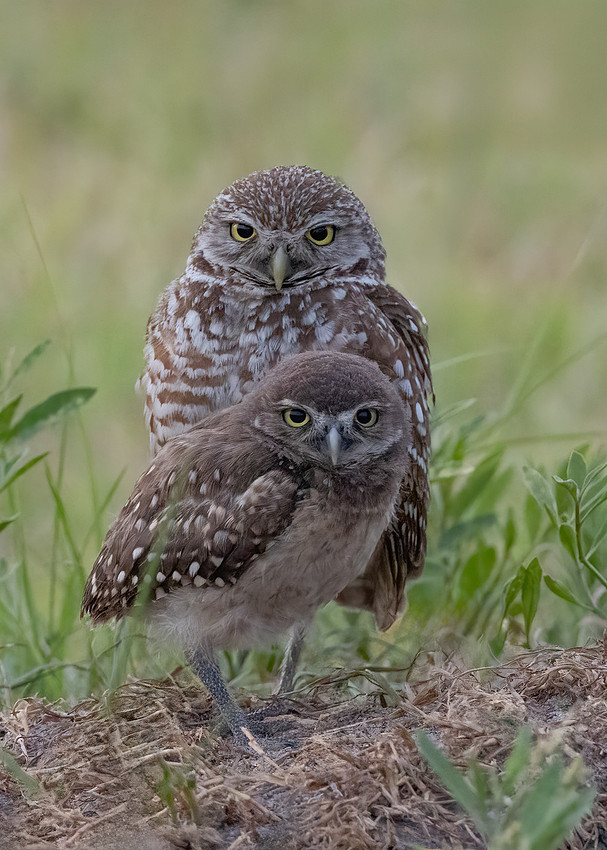
Burrowing Owls
We drove to Florida,
In search of burrowing owls.
No trailhead.
No signpost.
Just a tip: "Try the library.”
Looking at the vacant lot,
I did not notice them at first.
Weeds.
Brown grass.
Wait—two eyes.
No, four.
They are there.
Hidden.
They had been there all along.
Burrowing owls!
Small sentries.
In a sunburnt field.
Standing dutifully on sandy mounds.
Not even 12 inches tall.
The ground is their home.
Hollowed tunnels.
In South Florida sand.
Each burrow designated.
By wooden stakes.
Adorned by a wooden perch.
They live beside sidewalks.
They live in vacant lots.
They live in front yards,
With perfect grass.
You can call a number.
Get instructions.
Build a mound.
The owls will come.
No shrubs.
No trees.
They want a clean view,
To watch for danger.
In February, only the adults.
Alert.
Unblinking.
Stoic.
By April, the story changed.
Tiny heads.
Wobbling legs.
Wide eyes.
Fluff and wonder.
The babies had arrived!
I walked the neighborhoods.
100–500mm lens in hand.
Teleconverter clicked in place.
I saw them.
They saw me.
They look to my right.
They look to my left.
Rarely making eye contact.
Yellow eyes.
Sometimes brown.
Wide as moons.
If the adult cries out,
The babies vanish underground.
It's like watching a magic trick,
Performed by feathered magicians.
Some say they look like old men.
I say: They look like charming lawn ornaments.
Tiny sentinels with trust issues.
Always on duty.
Always a delight.